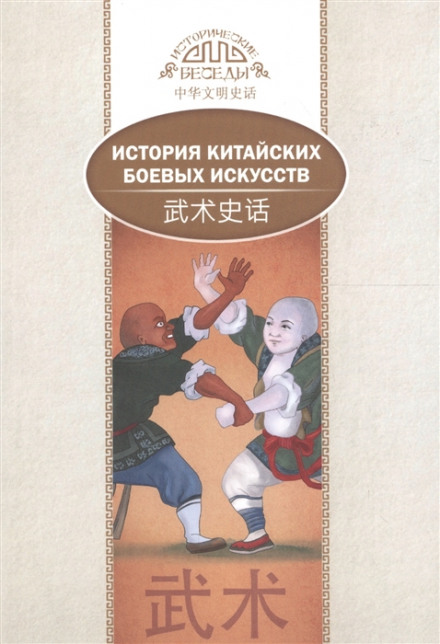
History of Chinese Martial Arts
3 hrs. 39 min.
Description
Wushu is the collective name for all Chinese martial arts. This book will introduce you to the history of wushu and its special techniques, combat ethics, types of weapons, and boxing styles. You’ll learn about the features of Shaolin wushu, the mountains of Wudangshan, Emeishan, and Kuntunshan, as well as the influence of martial arts on Chinese culture.
For a wide audience.
The origins of Chinese martial arts probably date back to times not reflected in any historical document. Combat techniques were discovered or developed over a long period of uninterrupted clashes between people and animals—or between different tribes of people. Experience accumulated from such fights, and techniques created based on it were passed down from generation to generation.
Later, weapons appeared—clubs, stones, or animal bones. New types and forms of weapons emerged, and finally iron was discovered. At first, metal weapons were made from copper, tin, and bronze. Millennia passed, metallurgy advanced, and weapons gradually became stronger and sharper. Following the development of weapons, new combat techniques arose.
Different schools and styles appeared, “testing each other’s strength.” Many of these schools or styles created new forms by imitating fighting techniques of various animals (tiger, panther, monkey, bear), reptiles (snakes), birds (eagle, crane, rooster), or insects (mantis). The Chinese believed that animals possess natural fighting qualities and abilities necessary to survive harsh conditions of nature, so studying and imitating them was the best way to master effective combat techniques. For example, they imitated the sharpness and powerful talons of the eagle, the sudden leaps of the tiger, and the attacking movements of the beak and wings of the crane.
Because these combat techniques first emerged in ancient times, they gradually became part of Chinese culture. In turn, the philosophy and culture of these martial arts were influenced by other elements of Chinese culture. Thus, the philosophy of Yin-Yang and Taijiquan began to be applied in techniques, and based on the concept of Bagua (Eight Trigrams), combat strategy and tactics were developed.
Chinese culture arose on the banks of the Yellow River and over many thousands of years spread throughout Asia. Neighboring countries call China Zhong guo, which means “the central state.” This is explained by the fact that the history of China, spanning more than seven thousand years, is much richer and longer not only in terms of culture, religion, and science, but also in many other areas.
Different schools and styles appeared, “testing each other’s strength.” Many of these schools or styles created new forms by imitating fighting techniques of various animals (tiger, panther, monkey, bear), reptiles (snakes), birds (eagle, crane, rooster), or insects (mantis). The Chinese believed that animals possess natural fighting qualities and abilities necessary to survive harsh conditions of nature, so studying and imitating them was the best way to master effective combat techniques. For example, they imitated the sharpness and powerful talons of the eagle, the sudden leaps of the tiger, and the attacking movements of the beak and wings of the crane.
Because these combat techniques first emerged in ancient times, they gradually became part of Chinese culture. In turn, the philosophy and culture of these martial arts were influenced by other elements of Chinese culture. Thus, the philosophy of Yin-Yang and Taijiquan began to be applied in techniques, and based on the concept of Bagua (Eight Trigrams), combat strategy and tactics were developed.
For a wide audience.
The origins of Chinese martial arts probably date back to times not reflected in any historical document. Combat techniques were discovered or developed over a long period of uninterrupted clashes between people and animals—or between different tribes of people. Experience accumulated from such fights, and techniques created based on it were passed down from generation to generation.
Later, weapons appeared—clubs, stones, or animal bones. New types and forms of weapons emerged, and finally iron was discovered. At first, metal weapons were made from copper, tin, and bronze. Millennia passed, metallurgy advanced, and weapons gradually became stronger and sharper. Following the development of weapons, new combat techniques arose.
Different schools and styles appeared, “testing each other’s strength.” Many of these schools or styles created new forms by imitating fighting techniques of various animals (tiger, panther, monkey, bear), reptiles (snakes), birds (eagle, crane, rooster), or insects (mantis). The Chinese believed that animals possess natural fighting qualities and abilities necessary to survive harsh conditions of nature, so studying and imitating them was the best way to master effective combat techniques. For example, they imitated the sharpness and powerful talons of the eagle, the sudden leaps of the tiger, and the attacking movements of the beak and wings of the crane.
Because these combat techniques first emerged in ancient times, they gradually became part of Chinese culture. In turn, the philosophy and culture of these martial arts were influenced by other elements of Chinese culture. Thus, the philosophy of Yin-Yang and Taijiquan began to be applied in techniques, and based on the concept of Bagua (Eight Trigrams), combat strategy and tactics were developed.
Chinese culture arose on the banks of the Yellow River and over many thousands of years spread throughout Asia. Neighboring countries call China Zhong guo, which means “the central state.” This is explained by the fact that the history of China, spanning more than seven thousand years, is much richer and longer not only in terms of culture, religion, and science, but also in many other areas.
Different schools and styles appeared, “testing each other’s strength.” Many of these schools or styles created new forms by imitating fighting techniques of various animals (tiger, panther, monkey, bear), reptiles (snakes), birds (eagle, crane, rooster), or insects (mantis). The Chinese believed that animals possess natural fighting qualities and abilities necessary to survive harsh conditions of nature, so studying and imitating them was the best way to master effective combat techniques. For example, they imitated the sharpness and powerful talons of the eagle, the sudden leaps of the tiger, and the attacking movements of the beak and wings of the crane.
Because these combat techniques first emerged in ancient times, they gradually became part of Chinese culture. In turn, the philosophy and culture of these martial arts were influenced by other elements of Chinese culture. Thus, the philosophy of Yin-Yang and Taijiquan began to be applied in techniques, and based on the concept of Bagua (Eight Trigrams), combat strategy and tactics were developed.
100%
05:52
01_Istoriya kitayskih boevyh iskusstv
01:08
02_Istoriya kitayskih boevyh iskusstv
26:09
03_Istoriya kitayskih boevyh iskusstv
03:32
04_Istoriya kitayskih boevyh iskusstv
05:31
05_Istoriya kitayskih boevyh iskusstv
03:55
06_Istoriya kitayskih boevyh iskusstv
02:15
07_Istoriya kitayskih boevyh iskusstv
03:37
08_Istoriya kitayskih boevyh iskusstv
04:32
09_Istoriya kitayskih boevyh iskusstv
02:24
10_Istoriya kitayskih boevyh iskusstv
10:25
11_Istoriya kitayskih boevyh iskusstv
05:19
12_Istoriya kitayskih boevyh iskusstv
05:47
13_Istoriya kitayskih boevyh iskusstv
09:02
14_Istoriya kitayskih boevyh iskusstv
03:18
15_Istoriya kitayskih boevyh iskusstv
01:45
16_Istoriya kitayskih boevyh iskusstv
03:47
17_Istoriya kitayskih boevyh iskusstv
02:19
18_Istoriya kitayskih boevyh iskusstv
03:27
19_Istoriya kitayskih boevyh iskusstv
03:17
20_Istoriya kitayskih boevyh iskusstv
05:13
21_Istoriya kitayskih boevyh iskusstv
05:11
22_Istoriya kitayskih boevyh iskusstv
03:50
23_Istoriya kitayskih boevyh iskusstv
08:53
24_Istoriya kitayskih boevyh iskusstv
04:34
25_Istoriya kitayskih boevyh iskusstv
02:38
26_Istoriya kitayskih boevyh iskusstv
10:02
27_Istoriya kitayskih boevyh iskusstv
10:21
28_Istoriya kitayskih boevyh iskusstv
09:23
29_Istoriya kitayskih boevyh iskusstv
05:19
30_Istoriya kitayskih boevyh iskusstv
07:28
31_Istoriya kitayskih boevyh iskusstv
03:09
32_Istoriya kitayskih boevyh iskusstv
01:46
33_Istoriya kitayskih boevyh iskusstv
01:18
34_Istoriya kitayskih boevyh iskusstv
04:23
35_Istoriya kitayskih boevyh iskusstv
01:05
36_Istoriya kitayskih boevyh iskusstv
05:32
37_Istoriya kitayskih boevyh iskusstv
05:20
38_Istoriya kitayskih boevyh iskusstv
03:04
39_Istoriya kitayskih boevyh iskusstv
04:57
40_Istoriya kitayskih boevyh iskusstv
06:16
41_Istoriya kitayskih boevyh iskusstv
02:21
42_Istoriya kitayskih boevyh iskusstv
