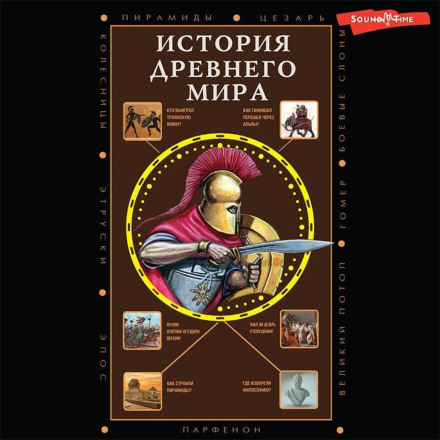
History of the Ancient World
7 hrs. 49 min.
Language
Russian
Author
Sergey Nechaev
Author
Sergey Nechaev
Narrator
Evgeny Lebedev
Narrator
Evgeny Lebedev
Description
Numerous scholarly works and museum exhibitions convince us that almost everything is known about human history, and that for practically any question historians have an answer. Yet if we look into the distant past more closely, we’ll find a great number of contradictions and inconsistencies. For example, why did medieval painters depict ancient characters as their contemporaries, dressed in the clothing of the artist’s own time? And how could ancient warriors strike their enemies with bronze swords if bronze is a brittle material and it’s difficult to obtain a good cutting blade from bronze? Why do excavations of tombs of Egyptian pharaohs yield steel weapons if Ancient Egypt didn’t know metal—or did it?
Or how, in the end, can we explain the steel chisel found in the pyramid of Khufu, built 2900 years before the Common Era?
The new book in the series “Complete History of the Epochs” will reveal the secrets of remote antiquity to the reader.
Or how, in the end, can we explain the steel chisel found in the pyramid of Khufu, built 2900 years before the Common Era?
The new book in the series “Complete History of the Epochs” will reveal the secrets of remote antiquity to the reader.
