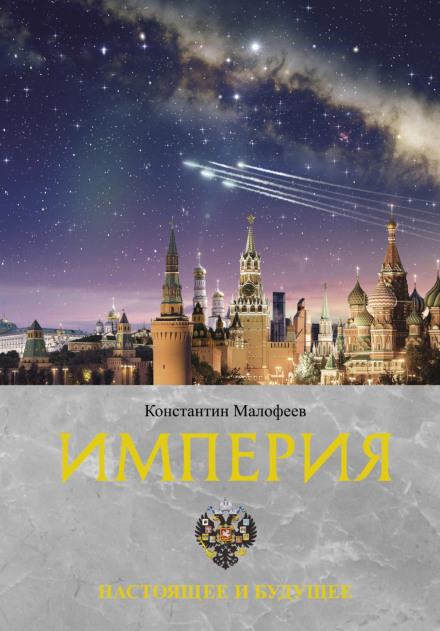
The Empire. Present and Future. Book Three (Collection)
19 hrs. 31 min.
Language
Russian
Author
Konstantin Malofeev
Author
Konstantin Malofeev
Narrator
Ivan Litvinov
Narrator
Ivan Litvinov
Description
A complete immersion into the history of the Russian Empire.
What is translatio imperii? What tradition did the Russian Empire inherit from Assyria, Persia, and Rome? What is Russia’s mission in world history?
Konstantin Malofeev’s book is devoted to the Empire—its past, present, and future. The author studies the interaction in world history between the imperial beginning based on religiously grounded power and the beginning of trade and finance.
Before the listener unfolds a grand historical panorama—Assyria and Babylon, Greece and Persia, Rome and Carthage, and so on all the way until the collapse of the Russian Empire, the establishment of the modern world order, and attempts to counter it. Great conquerors, prophets and saints, trading corporations and banking houses act on these pages.
In the first volume, the period of the Empire’s formation up to the fall of Constantinople in 1453 is considered.
In the second volume, the period from Russia’s acceptance of the imperial mission in the mid-15th century to the revolutionary upheavals of 1917 is examined.
In the third, final volume, the events of the 20th century and the beginning of the 21st century are covered—when the shattered Hananian Empire revived first as the Soviet state, and nowadays it is being revived again—as a real Orthodox Empire, by the efforts of Vladimir Putin. The rise and fall of the Soviet project, the establishment of the modern world order and attempts to resist it. Tracing the thousands-of-years history of the universal Empire and its struggle with the financial-oligarchic Hananian, the author concludes: without returning to fulfilling the sacred mission of the Empire—keeping the world from evil—the revival of Russia is impossible. How to arrange our Empire by breaking the chains of the globalist new world order? How to recreate finances and culture free from outside control, an uncorrupted bureaucracy, and responsible special services? In what form can monarchy be restored in Russia—without which a full-fledged Empire cannot exist?
The book offered to the reader answers these and many other questions.
On the one hand, the study is based on the best achievements of domestic and world historiography, and on the other, it offers original historiosophical ideas developed by the author over decades.
The book will be of interest to historians, philosophers, political scientists, and economists, as well as to students and a broad circle of history lovers.
What is translatio imperii? What tradition did the Russian Empire inherit from Assyria, Persia, and Rome? What is Russia’s mission in world history?
Konstantin Malofeev’s book is devoted to the Empire—its past, present, and future. The author studies the interaction in world history between the imperial beginning based on religiously grounded power and the beginning of trade and finance.
Before the listener unfolds a grand historical panorama—Assyria and Babylon, Greece and Persia, Rome and Carthage, and so on all the way until the collapse of the Russian Empire, the establishment of the modern world order, and attempts to counter it. Great conquerors, prophets and saints, trading corporations and banking houses act on these pages.
In the first volume, the period of the Empire’s formation up to the fall of Constantinople in 1453 is considered.
In the second volume, the period from Russia’s acceptance of the imperial mission in the mid-15th century to the revolutionary upheavals of 1917 is examined.
In the third, final volume, the events of the 20th century and the beginning of the 21st century are covered—when the shattered Hananian Empire revived first as the Soviet state, and nowadays it is being revived again—as a real Orthodox Empire, by the efforts of Vladimir Putin. The rise and fall of the Soviet project, the establishment of the modern world order and attempts to resist it. Tracing the thousands-of-years history of the universal Empire and its struggle with the financial-oligarchic Hananian, the author concludes: without returning to fulfilling the sacred mission of the Empire—keeping the world from evil—the revival of Russia is impossible. How to arrange our Empire by breaking the chains of the globalist new world order? How to recreate finances and culture free from outside control, an uncorrupted bureaucracy, and responsible special services? In what form can monarchy be restored in Russia—without which a full-fledged Empire cannot exist?
The book offered to the reader answers these and many other questions.
On the one hand, the study is based on the best achievements of domestic and world historiography, and on the other, it offers original historiosophical ideas developed by the author over decades.
The book will be of interest to historians, philosophers, political scientists, and economists, as well as to students and a broad circle of history lovers.
