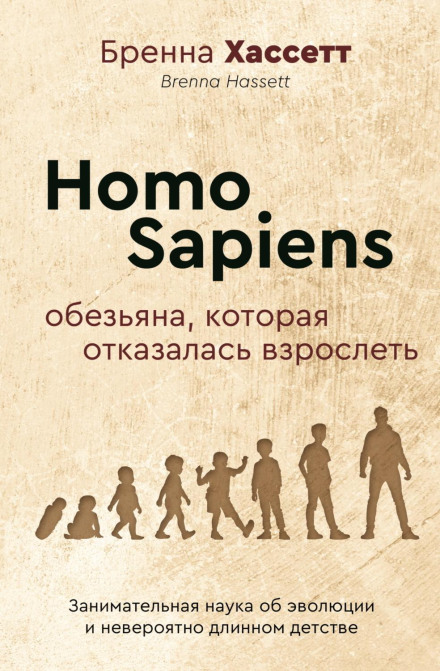
Homo Sapiens. The Ape That Refused to Grow Up. Entertaining Science About Evolution and an Incredibly Long Childhood
12 hrs. 30 min.
Language
Russian
Author
Brenna Hassett
Author
Brenna Hassett
Narrator
Irina Bulekova
Narrator
Irina Bulekova
Description
Anthropologist and bioarchaeologist Brenna Hassett challenges traditional views of the evolution of Homo sapiens, answering key questions:
• How and why did humans appear two million years ago?
• Why is the human growth and maturation period so disproportionately long from a biological perspective?
• How are fertility and fat connected in nature?
• What conclusions about evolution can be drawn by studying teeth?
• Why does humanity talk so much, and how did it survive with only a 30% likelihood of pregnancy?
By studying primates and archaeological finds, the author explores human evolution from diet and breast milk composition to our love of formal education. She analyzes how we developed in a state of “endless” childhood and what adaptive mechanisms determine our present-day behavior.
This work will become a treasure trove of knowledge for educators, young parents, and a wide circle of readers, helping them understand how we became what we are. The book promises intellectual pleasure and takes a worthy place in scientific literature alongside works by Yuval Noah Harari and Jared Diamond.
“Evolution is complex, and we constantly find new factors that make us reconsider established models” (Brenna Hassett).
• How and why did humans appear two million years ago?
• Why is the human growth and maturation period so disproportionately long from a biological perspective?
• How are fertility and fat connected in nature?
• What conclusions about evolution can be drawn by studying teeth?
• Why does humanity talk so much, and how did it survive with only a 30% likelihood of pregnancy?
By studying primates and archaeological finds, the author explores human evolution from diet and breast milk composition to our love of formal education. She analyzes how we developed in a state of “endless” childhood and what adaptive mechanisms determine our present-day behavior.
This work will become a treasure trove of knowledge for educators, young parents, and a wide circle of readers, helping them understand how we became what we are. The book promises intellectual pleasure and takes a worthy place in scientific literature alongside works by Yuval Noah Harari and Jared Diamond.
“Evolution is complex, and we constantly find new factors that make us reconsider established models” (Brenna Hassett).
100%
23:34
01
35:31
02
37:35
03
36:58
04
37:44
05
44:11
06
41:09
07
30:09
08
47:25
09
33:21
10
43:24
11
30:00
12
42:00
13
34:37
14
32:51
15
34:04
16
32:53
17
36:39
18
34:19
19
41:05
20
21:26
21
