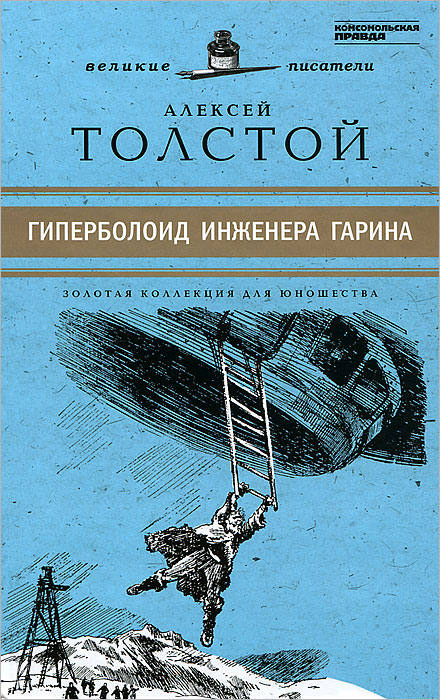
The Garin Death Ray
12 hrs. 4 min.
Language
Russian
Author
Alexey Nikolayevich Tolstoy
Author
Alexey Nikolayevich Tolstoy
Narrator
Alexander Bordukov
Narrator
Alexander Bordukov
Description
— a fantastic novel by A. N. Tolstoy, completed by 1927. The creation of this novel was inspired by the captivating image of the Shukhov Tower structure, built in 1922 as vertically rising sections—hyperboloids.
In the article “How We Write” (December 1929), Tolstoy reports: “When I was writing ‘The Hyperboloid of Engineer Garin,’ my old acquaintance Olenin told me the real story of the construction of such a double hyperboloid. The engineer who made this discovery died in Siberia. I had to acquaint myself with the newest theories of molecular physics. Much helped me Academician P. P. Lazarev.” According to the author, the first part of the novel is adventurous, the second is heroic, and the third is utopian.
Russian engineer Pyotr Petrovich Garin, using his teacher Mantsev’s developments—who later disappeared with an expedition in Siberian taiga—creates a “hyperboloid”: a device that emits a thermal beam of enormous power, capable of destroying any obstacles. Garin brings over to his side an American industrialist and financier, the millionaire Rollings, using his apparatus to destroy the factories of his German competitors. With Rollings’s funds, Garin takes over an uninhabited island in the Pacific Ocean, where, with the help of the hyperboloid, he begins extracting gold from the Earth’s previously unreachable depths. Gaining access to unlimited gold reserves, Garin undermines the gold parity, triggering the most severe financial crisis in the capitalist world—thanks to which he buys up U.S. industry and becomes a dictator under the name Pierre Harry. But soon his dictatorship collapses as a result of the hyperboloid being seized by a group of revolutionaries led by a Soviet agent, a criminal investigation officer named Shelga, and then by an all-encompassing uprising of the workers…
In the article “How We Write” (December 1929), Tolstoy reports: “When I was writing ‘The Hyperboloid of Engineer Garin,’ my old acquaintance Olenin told me the real story of the construction of such a double hyperboloid. The engineer who made this discovery died in Siberia. I had to acquaint myself with the newest theories of molecular physics. Much helped me Academician P. P. Lazarev.” According to the author, the first part of the novel is adventurous, the second is heroic, and the third is utopian.
Russian engineer Pyotr Petrovich Garin, using his teacher Mantsev’s developments—who later disappeared with an expedition in Siberian taiga—creates a “hyperboloid”: a device that emits a thermal beam of enormous power, capable of destroying any obstacles. Garin brings over to his side an American industrialist and financier, the millionaire Rollings, using his apparatus to destroy the factories of his German competitors. With Rollings’s funds, Garin takes over an uninhabited island in the Pacific Ocean, where, with the help of the hyperboloid, he begins extracting gold from the Earth’s previously unreachable depths. Gaining access to unlimited gold reserves, Garin undermines the gold parity, triggering the most severe financial crisis in the capitalist world—thanks to which he buys up U.S. industry and becomes a dictator under the name Pierre Harry. But soon his dictatorship collapses as a result of the hyperboloid being seized by a group of revolutionaries led by a Soviet agent, a criminal investigation officer named Shelga, and then by an all-encompassing uprising of the workers…
