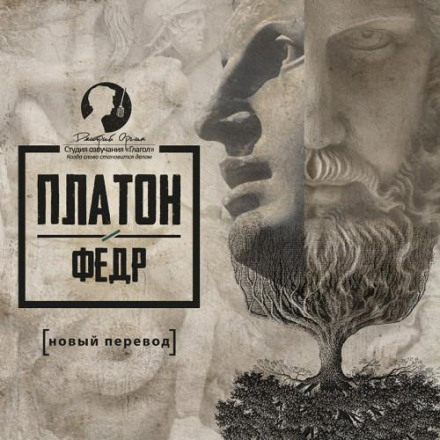
Phaedrus
2 hrs. 51 min.
Description
"We should understand the reason for the loss of wings and why they fall off the soul."
According to the handwritten tradition, the dialogue "Phaedrus" has two versions of its subtitle: "about the beautiful" or "about eros." Manuscripts also specify the genre of the work: an ethical dialogue. Although all these clarifications belong not to the author but are later insertions, the purpose of writing "Phaedrus" has always interested its readers and became a stumbling block for specialists.
The dialogue "Phaedrus" is one of Plato’s most controversial works, giving rise to a long trail of interpretations, the earliest of which emerged already in Antiquity. The subject of the dialogue has been named as love, rhetorical art, the soul’s principle, and even the diversity of the beautiful in general. The poetic imagery of "Phaedrus" makes us reconsider established ideas about the work of the great Greek, while the logical paradoxes of this text challenge modern philosophical and literary-theoretical theories.
Translation
For any developed scholarly tradition, it is normal to regularly turn to classical texts in order to reconsider existing translations and interpretations. Over recent decades, changing the scholarly horizon, scholarly language, the accumulation of new data, and the appearance of new interpretations of historical and philosophical doctrines—doctrines that seemed textbook-like and unshakable—has taken on a cumulative character. All this leaves its mark on translation work: translations do not merely clarify certain details or shortcomings. They are prepared from other methodological positions and take into account—so far as possible—the foreign research experience available on the Platonic corpus (where the emergence of new translations of classical texts every 20–25 years is the norm).
This translation was prepared as part of the activities of the Platonic Philosophical Society.
According to the handwritten tradition, the dialogue "Phaedrus" has two versions of its subtitle: "about the beautiful" or "about eros." Manuscripts also specify the genre of the work: an ethical dialogue. Although all these clarifications belong not to the author but are later insertions, the purpose of writing "Phaedrus" has always interested its readers and became a stumbling block for specialists.
The dialogue "Phaedrus" is one of Plato’s most controversial works, giving rise to a long trail of interpretations, the earliest of which emerged already in Antiquity. The subject of the dialogue has been named as love, rhetorical art, the soul’s principle, and even the diversity of the beautiful in general. The poetic imagery of "Phaedrus" makes us reconsider established ideas about the work of the great Greek, while the logical paradoxes of this text challenge modern philosophical and literary-theoretical theories.
Translation
For any developed scholarly tradition, it is normal to regularly turn to classical texts in order to reconsider existing translations and interpretations. Over recent decades, changing the scholarly horizon, scholarly language, the accumulation of new data, and the appearance of new interpretations of historical and philosophical doctrines—doctrines that seemed textbook-like and unshakable—has taken on a cumulative character. All this leaves its mark on translation work: translations do not merely clarify certain details or shortcomings. They are prepared from other methodological positions and take into account—so far as possible—the foreign research experience available on the Platonic corpus (where the emergence of new translations of classical texts every 20–25 years is the norm).
This translation was prepared as part of the activities of the Platonic Philosophical Society.
