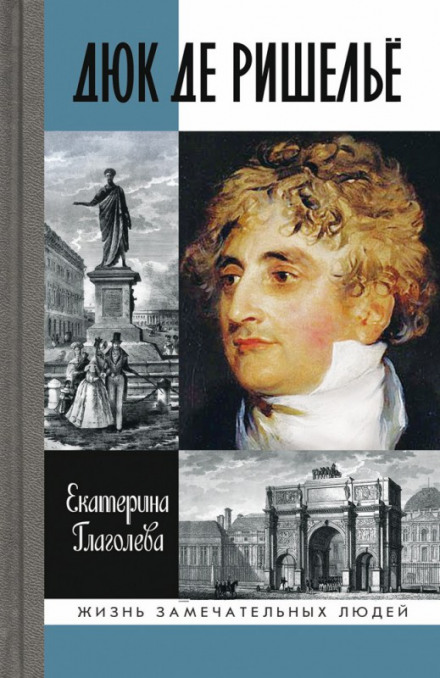
Duke de Richelieu
17 hrs. 22 min.
Language
Russian
Author
Ekaterina Glagoleva
Author
Ekaterina Glagoleva
Narrator
Mikhail Roslyakov
Narrator
Mikhail Roslyakov
Description
Armand Emmanuel du Plessis, 5th Duke de Richelieu (1766?–1822), received in Russia the name Emmanuel Osipovich and was immortalized in bronze as the Duke. A great-great-grandnephew of the famous cardinal and the grandson of a marshal, he was forced to leave his homeland during the revolutionary upheavals. He participated in the bloody assault on the Turkish fortress of Izmail as a volunteer; for 24 years he served “his adopted homeland”—Russia—faithfully. As governor-general, he fought ossification, ignorance, and bribery so that a thriving city, Odessa, would rise where there had been only a shabby settlement.
Returning to devastated France, he as head of government waged exhausting cabinet battles for the country’s independence and prosperity—but he did not become a courtier, remaining “a stranger among his own.” His boundless capacity to love had to squeeze itself at the edge of his dream of personal happiness. The Russian Emperor Alexander I called the Duke his only friend who spoke the truth to him, and the English Duke Wellington believed that “the word of Richelieu is worth a treatise.” He carried his family name with honor and earned a worthy place in the history of France, Russia, and Ukraine.
Returning to devastated France, he as head of government waged exhausting cabinet battles for the country’s independence and prosperity—but he did not become a courtier, remaining “a stranger among his own.” His boundless capacity to love had to squeeze itself at the edge of his dream of personal happiness. The Russian Emperor Alexander I called the Duke his only friend who spoke the truth to him, and the English Duke Wellington believed that “the word of Richelieu is worth a treatise.” He carried his family name with honor and earned a worthy place in the history of France, Russia, and Ukraine.
100%
01:50
00-01-annotatsiya
10:57
01-00-prolog
21:29
01-01-rodoslovnaya
36:03
01-02-uchene-i-svet
37:08
01-03-smutnoe-vremya
35:47
02-01-boevoe-kreschenie
39:30
02-02-frantsiya-ili-rossiya
31:17
02-03-rubikon
24:08
02-04-01-nemilost
23:06
02-04-02-nemilost
30:42
02-05-novyy-povorot
21:51
03-01-01-pervye-shagi
23:21
03-01-02-pervye-shagi
22:22
03-01-03-pervye-shagi
20:24
03-02-01-novyy-vavilon
22:34
03-02-02-novyy-vavilon
22:25
03-03-01-na-dva-fronta
23:04
03-03-02-na-dva-fronta
24:56
03-03-03-na-dva-fronta
20:59
03-04-01-chelovek-bo-esm
22:21
03-04-02-chelovek-bo-esm
20:13
03-04-03-chelovek-bo-esm
35:17
03-05-predchuvstvie-voyny
21:33
03-06-01-chuma
22:36
03-06-02-chuma
21:07
03-06-03-chuma
28:50
03-06-04-chuma
17:29
04-01-tantsuyuschiy-kongress
33:13
04-02-100-dney
27:43
04-03-01-chelovek-predpolagaet
24:31
04-03-02-chelovek-predpolagaet
26:18
04-04-01-minuy-nas-pusche-vseh-pechaley
25:40
04-04-02-minuy-nas-pusche-vseh-pechaley
32:35
04-05-01-lyudi-gibnut-za-metall
19:54
04-05-02-lyudi-gibnut-za-metall
18:29
04-05-03-lyudi-gibnut-za-metall
21:47
04-05-04-lyudi-gibnut-za-metall
20:21
04-06-01-posledniy-krug
22:22
04-06-02-posledniy-krug
18:57
04-06-03-posledniy-krug
27:07
04-06-04-posledniy-krug
21:32
05-epilog
11:52
06-osnovnye-daty-dyuka-de-rishelya
06:54
07-bibliografiya
