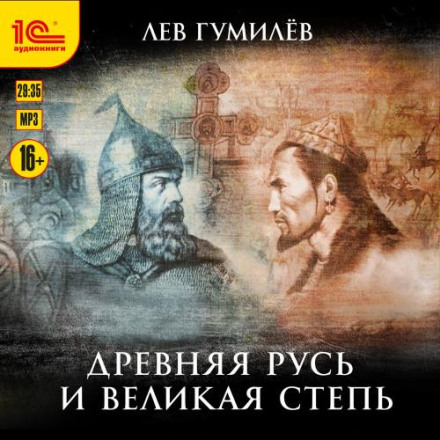
Ancient Rus and the Great Steppe
29 hrs. 35 min.
Language
Russian
Author
Lev Gumilyov
Author
Lev Gumilyov
Narrator
Maxim Suslov
Narrator
Maxim Suslov
Description
Lev Nikolaevich Gumilev (1912–1992) is a Russian Soviet scholar: archaeologist, orientalist, geographer, ethnologist, creator of the theory of passionarity in ethnogenesis. Son of Anna Akhmatova and Nikolai Gumilev, who was executed in 1921 on a fabricated charge of participating in an anti-Soviet conspiracy. For his views, Lev Gumilev was repeatedly subjected to repression. In the final years of the Great Patriotic War he fought in the ranks of the Red Army and received awards. However, after the war he was condemned again and rehabilitated only in 1956. Both in the camps and after his release, he worked on writing various scholarly works. In his research, Lev Gumilev adhered to Eurasianist ideas; his works still provoke heated debates among ethnologists and historians.
“Ancient Rus’ and the Great Steppe” is a large monograph devoted to studying the relationship between Ancient Rus’ and its neighbors, mainly the nomads. The author tries to recreate a coherent picture of the ethnical history of that period. Gumilev’s theory sparked serious disputes in the academic community and was rejected by most historians. But his book continues to attract the attention of the general public. We offer you the opportunity to get acquainted with this substantial work in audio format.
“Ancient Rus’ and the Great Steppe” is a large monograph devoted to studying the relationship between Ancient Rus’ and its neighbors, mainly the nomads. The author tries to recreate a coherent picture of the ethnical history of that period. Gumilev’s theory sparked serious disputes in the academic community and was rejected by most historians. But his book continues to attract the attention of the general public. We offer you the opportunity to get acquainted with this substantial work in audio format.
100%
1:01:56
001
51:06
002
58:17
003
43:32
004
1:09:33
005
46:15
006
31:54
007
1:18:52
008
53:22
009
43:25
010
1:02:25
011
1:03:46
012
46:28
013
43:16
014
1:30:48
015
1:09:07
016
39:55
017
42:27
018
50:07
019
51:40
020
1:31:02
021
1:05:26
022
1:06:48
023
46:21
024
53:35
025
1:15:16
026
25:27
027
43:40
028
34:09
029
32:04
030
21:17
031
52:52
032
24:02
033
45:01
034
