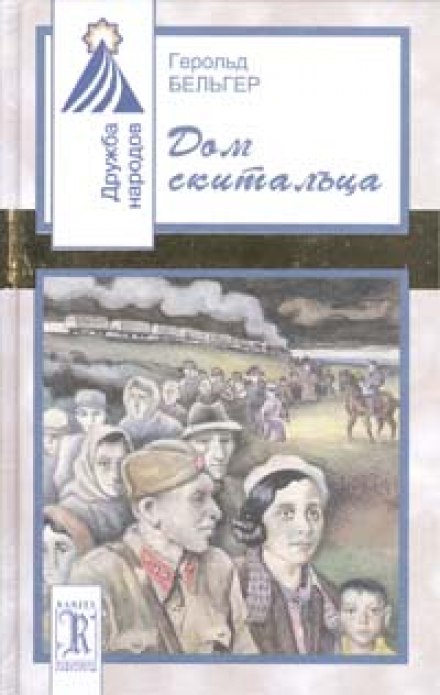
The Wanderer's Home
13 hrs. 38 min.
Language
Russian
Author
Gerold Belger
Author
Gerold Belger
Narrator
Zura Dzhumagulova
Narrator
Zura Dzhumagulova
Description
The house where the young deportee Herold Belgier lived together with his unfortunate relatives has unfortunately not survived. The Aul people did not think to turn this house into a museum of creativity of their famous fellow countryman, whose works are understandable to Kazakhs, Russians, and Germans alike, or to open here a museum of deportation—an unspoken reproach of history.
A kind of deportation museum became Herold Belgier’s novel “The House of the Wanderer,” reflecting the dramatic fate of Soviet Germans who were subjected in 1941 to mass resettlement.
The author begins the search for a home (homeland) already with an epigraph taken from A. Akhmatova: “But where is my home and where is my mind?” The table of contents of the novel, consisting of 3 chapters, indicates the author’s attention to the human being: the chapters are titled with the names of the heroes—“David,” “Khrištyan,” and “Garry.” Between the ages of these heroes there is about a ten-year gap: the chapters trace the fates of three consecutive generations of Russian Germans. Using a wealth of documentary facts and skillfully employing typification, Belgier unfolds before the reader the difficult history of Russian Germans and other Soviet people during the Great Patriotic War. Before the reader pass not only the characters named in the chapter titles, but also numerous secondary (Gaziz, Maruar, Baghira, Zharas, Nikolai Wagner, Lidiya, Yesilbay, Johann, and others) and episodic characters (Yakovchuk, Fogel, Frese, Viktor Klein, Viktoriyа, and others).
The tragedy of the narrative is felt immediately: in the contrast between the dry, harsh documentary order about deportation (epigraph to the first chapter) and the emotional fabric of fiction; in the absurdity and hopelessness of the first situation depicted—the assignment of the deported German feldsher David Erlich to work in a distant Kazakh aul.
A kind of deportation museum became Herold Belgier’s novel “The House of the Wanderer,” reflecting the dramatic fate of Soviet Germans who were subjected in 1941 to mass resettlement.
The author begins the search for a home (homeland) already with an epigraph taken from A. Akhmatova: “But where is my home and where is my mind?” The table of contents of the novel, consisting of 3 chapters, indicates the author’s attention to the human being: the chapters are titled with the names of the heroes—“David,” “Khrištyan,” and “Garry.” Between the ages of these heroes there is about a ten-year gap: the chapters trace the fates of three consecutive generations of Russian Germans. Using a wealth of documentary facts and skillfully employing typification, Belgier unfolds before the reader the difficult history of Russian Germans and other Soviet people during the Great Patriotic War. Before the reader pass not only the characters named in the chapter titles, but also numerous secondary (Gaziz, Maruar, Baghira, Zharas, Nikolai Wagner, Lidiya, Yesilbay, Johann, and others) and episodic characters (Yakovchuk, Fogel, Frese, Viktor Klein, Viktoriyа, and others).
The tragedy of the narrative is felt immediately: in the contrast between the dry, harsh documentary order about deportation (epigraph to the first chapter) and the emotional fabric of fiction; in the absurdity and hopelessness of the first situation depicted—the assignment of the deported German feldsher David Erlich to work in a distant Kazakh aul.
100%
00:23
00-00-belger-g-dom-skitaltsa-dzhumagulova-z
01:07
00-01-o-romane
01:14
01-00-david
21:48
01-01-david
15:27
01-02-david
13:14
01-03-david
11:07
01-04-david
15:26
01-05-david
09:20
01-06-david
04:55
01-07-david
17:38
01-08-david
07:13
01-09-david
09:44
01-10-david
18:15
01-11-david
11:26
01-12-david
27:52
01-13-david
25:06
01-14-david
07:48
02-01-hristian
31:58
02-02-hristian
26:22
02-03-hristian
28:19
02-04-hristian
26:02
02-05-hristian
26:57
02-06-hristian
18:09
02-07-hristian
30:15
02-08-hristian
49:52
02-09-hristian
28:09
02-10-hristian
30:11
03-01-garri
40:15
03-02-garri
45:54
03-03-garri
30:59
03-04-garri
15:20
03-05-garri
43:45
03-06-garri
16:24
03-07-garri
08:12
03-08-garri
33:00
03-09-garri
19:20
03-10-garri
35:35
03-11-garri
14:20
03-12-garri
