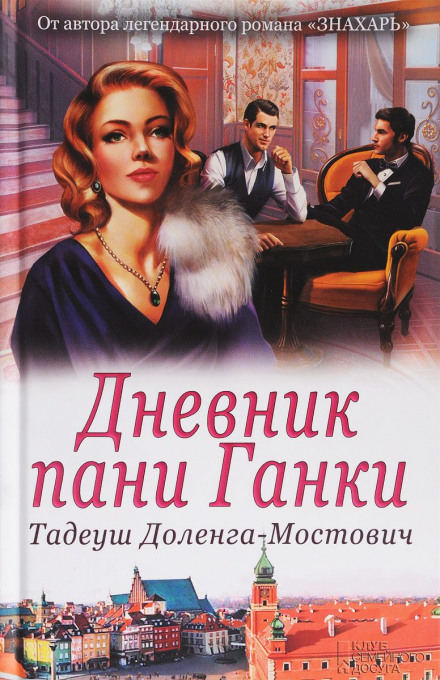
The Diary of Pani Hanka
14 hrs. 45 min.
Language
Russian
Author
Tadeusz Dołęga-Mostowicz
Author
Tadeusz Dołęga-Mostowicz
Narrator
Mikhail Roslyakov
Narrator
Mikhail Roslyakov
Description
Pani Hanka Renovitskaya, the young wife of a diplomat, read a letter addressed to her beloved husband and realized: he is married to someone else and a traitor. His first wife is trying to get back to her husband, Mr. Renovitsky. Pani Hanka sets up her own investigation, uncovers secrets about her husband, and plunges into worries, fantasies, conspiracies… Suspecting him of infidelity, she herself steps away from her promises.
But she still doesn’t know that her own romance will turn into a big surprise for her husband…
I believe that Pani Hanka Renovitskaya’s diary fully deserves to be published. It deserves distribution already as a document reflecting the customs and psychology of a modern cultured woman and her circle.
In times when hundreds of volumes of diverse biographies, autobiographies, and autobiographical novels written by workers, peasants, dancers, former smugglers, politicians, etc. are devoured, in my view there is no reason to deny oneself the chance to get acquainted with the diary of a woman belonging to the upper strata of society—those “ten thousand” who, in our country, set the tone and character of the epoch itself. I also think this document can be interesting, adding credibility to the literary landscape; it will be useful for a future historian of customs of the first half of the 20th century.
Handing it to the reader, I would like to point out that the greatest virtue of the diary lies in its astonishing candor, an honesty even its famous author couldn’t manage to achieve—toutе proportion gardée[1]—Jean-Jacques Rousseau. Madame Renovitskaya is not really acting here under her true surname, but the pseudonym cannot hide her identity from the discerning public. Her persona is well known in certain circles, and this lady can undoubtedly be recognized—especially considering that the events and people about whom it will be spoken are no secret to anyone.
Having performed, in these few sentences, the duties of presenting the author, I now give the floor to Pani Renovitskaya herself.
T. D.-M.
But she still doesn’t know that her own romance will turn into a big surprise for her husband…
I believe that Pani Hanka Renovitskaya’s diary fully deserves to be published. It deserves distribution already as a document reflecting the customs and psychology of a modern cultured woman and her circle.
In times when hundreds of volumes of diverse biographies, autobiographies, and autobiographical novels written by workers, peasants, dancers, former smugglers, politicians, etc. are devoured, in my view there is no reason to deny oneself the chance to get acquainted with the diary of a woman belonging to the upper strata of society—those “ten thousand” who, in our country, set the tone and character of the epoch itself. I also think this document can be interesting, adding credibility to the literary landscape; it will be useful for a future historian of customs of the first half of the 20th century.
Handing it to the reader, I would like to point out that the greatest virtue of the diary lies in its astonishing candor, an honesty even its famous author couldn’t manage to achieve—toutе proportion gardée[1]—Jean-Jacques Rousseau. Madame Renovitskaya is not really acting here under her true surname, but the pseudonym cannot hide her identity from the discerning public. Her persona is well known in certain circles, and this lady can undoubtedly be recognized—especially considering that the events and people about whom it will be spoken are no secret to anyone.
Having performed, in these few sentences, the duties of presenting the author, I now give the floor to Pani Renovitskaya herself.
T. D.-M.
100%
01:07
00_00_Dolenga-Mostovich_T_Dnevnik_pani_Ganki_Roslyakov_M
02:25
00_01_Predislovie
01:17
01_Moy dnevnik
27:59
02_Vtornik
23:01
03_Sreda
02:03
04_Chetverg
18:42
05_Pyatnitsa
21:49
06_Subbota
55:10
07_Voskresene
28:22
08_Vtornik
08:01
09_Sreda
00:36
10_Chetverg
27:45
11_Vtornik
05:16
12_Sreda
12:00
13_Chetverg
31:19
14_Chetverg
16:56
15_Pyatnitsa
13:51
16_Voskresene
10:55
17_Ponedelnik
10:17
18_Vtornik
14:49
19_Vtornik, vecher
04:34
20_Sreda
01:40
21_Chetverg
19:03
22_Pyatnitsa
24:48
23_Subbota
04:42
24_Voskresene
06:48
25_Ponedelnik
21:30
26_Vtornik
07:03
27_Sreda
47:27
28_Chetverg
02:57
29_Subbota
29:55
30_Subbota, vecher
05:11
31_Ponedelnik
02:14
32_Vtornik
02:39
33_Sreda
10:53
34_Chetverg
02:16
35_Subbota
25:31
36_Subbota
03:12
37_Ponedelnik
03:47
38_Vtornik
11:37
39_Sreda
27:35
40_Sreda
14:15
41_Chetverg
02:08
42_Pyatnitsa
00:39
43_Subbota
05:57
44_Voskresene
05:23
45_Ponedelnik
19:11
46_Vtornik
08:14
47_Sreda
01:08
48_Chetverg
01:01
49_Pyatnitsa
12:00
50_Voskresene
16:56
51_Vtornik
26:43
52_Pyatnitsa
00:22
53_Subbota
00:33
54_Voskresene
23:17
55_Ponedelnik
07:28
56_Ponedelnik, vecher
47:22
57_Vtornik
01:35
58_Chetverg, vecher
08:33
59_Pyatnitsa
31:21
60_Subbota
39:25
61_Subbota, vecher
09:26
62_Voskresene
01:25
63_Pyatnitsa
02:29
64_EPILOG
