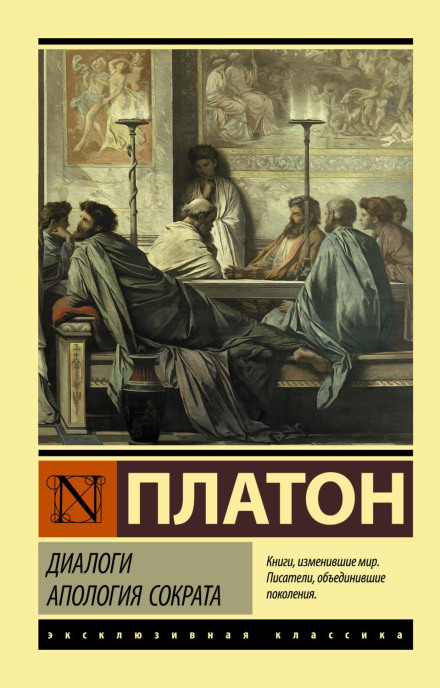
Dialogues. The Apology of Socrates
11 hrs. 4 min.
Description
Plato, the ancient Greek philosopher and idealist, was a student of Socrates and a mentor to Aristotle. With his work, philosophy becomes a system of knowledge. “Apology of Socrates” is the first surviving text by Plato, written shortly after Socrates’s trial and the only one not composed in the form of a dialogue.
Why did the Athenians decide to execute Socrates, whom the Delphic oracle considered the wisest man—and who became famous for his saying: “I know that I know nothing”? At the trial, he concluded his speech with words that nothing is known to anyone except the god what is better—death or life.
All of Plato’s other works are written as dialogues, where, through questions and answers, concepts such as duty, beauty, knowledge, ignorance, truth, lies, good, and evil are explored. This collection includes the dialogues “Euthyphro,” “Crito,” and “Phaedo,” describing the last days of Socrates, as well as “The Symposium” and “Phaedrus.”
Why did the Athenians decide to execute Socrates, whom the Delphic oracle considered the wisest man—and who became famous for his saying: “I know that I know nothing”? At the trial, he concluded his speech with words that nothing is known to anyone except the god what is better—death or life.
All of Plato’s other works are written as dialogues, where, through questions and answers, concepts such as duty, beauty, knowledge, ignorance, truth, lies, good, and evil are explored. This collection includes the dialogues “Euthyphro,” “Crito,” and “Phaedo,” describing the last days of Socrates, as well as “The Symposium” and “Phaedrus.”
