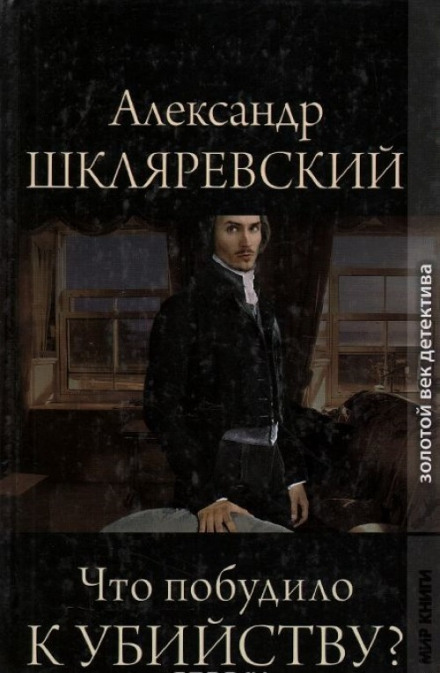
What Prompted the Murder
15 hrs. 37 min.
Language
Russian
Author
Alexander Shklyarevsky
Author
Alexander Shklyarevsky
Narrator
Sibiryak
Narrator
Sibiryak
Description
The Russian storyteller Alexander Andreevich Shklyarevsky (1837–1883), according to V. V. Krestovsky, belonged to the “working class of journal literature,” which—quite justly—can be called the literary convict class.
All his life Shklyarevsky was forced to fight poverty. For more than ten years he taught, publishing articles in various newspapers and magazines at the same time. A man generously endowed with talent, he achieved neither financial benefits nor literary recognition, although he is precisely the one who can be called “the father of the Russian detective story.”
Shklyarevsky earned his fame as the “Russian Gaboriau” in the late 1860s as the author of numerous criminal tales and novels.
In Shklyarevsky’s “criminal” works, the name of the criminal is often known to the reader already in the middle of the book. The main focus is not the detective and the investigation process, but the criminal’s experiences and the reasons that drove him to crime. In this sense, the novel published in this volume, “What Led to Murder?”, is indicative.
All his life Shklyarevsky was forced to fight poverty. For more than ten years he taught, publishing articles in various newspapers and magazines at the same time. A man generously endowed with talent, he achieved neither financial benefits nor literary recognition, although he is precisely the one who can be called “the father of the Russian detective story.”
Shklyarevsky earned his fame as the “Russian Gaboriau” in the late 1860s as the author of numerous criminal tales and novels.
In Shklyarevsky’s “criminal” works, the name of the criminal is often known to the reader already in the middle of the book. The main focus is not the detective and the investigation process, but the criminal’s experiences and the reasons that drove him to crime. In this sense, the novel published in this volume, “What Led to Murder?”, is indicative.
100%
03:05
01_01_Chto pobudilo k ubiystvu
11:42
01_02_Chto pobudilo k ubiystvu
29:25
01_03_Chto pobudilo k ubiystvu
14:32
01_04_Chto pobudilo k ubiystvu
17:11
01_05_Chto pobudilo k ubiystvu
19:23
01_06_Chto pobudilo k ubiystvu
26:35
01_07_Chto pobudilo k ubiystvu
36:18
01_08_Chto pobudilo k ubiystvu
29:21
01_09_Chto pobudilo k ubiystvu
05:18
01_10_Chto pobudilo k ubiystvu
06:36
02_01_Rasskaz sudebnogo sledovatelya
13:46
02_02_Rasskaz sudebnogo sledovatelya
14:55
02_03_Rasskaz sudebnogo sledovatelya
58:23
02_04_Rasskaz sudebnogo sledovatelya
22:53
02_05_Rasskaz sudebnogo sledovatelya
21:32
02_06_Rasskaz sudebnogo sledovatelya
41:07
02_07_Rasskaz sudebnogo sledovatelya
21:40
03_01_Sekretnoe Sledstvie
55:44
03_02_Sekretnoe Sledstvie
26:20
03_03_Sekretnoe Sledstvie
37:02
03_04_Sekretnoe Sledstvie
12:47
03_05_Sekretnoe Sledstvie
40:23
03_06_Sekretnoe Sledstvie
12:26
03_07_Sekretnoe Sledstvie
05:57
03_08_Sekretnoe Sledstvie
33:46
03_09_Sekretnoe Sledstvie
02:07
03_10_Sekretnoe Sledstvie
03:59
04_01_Otpetyy
09:47
04_02_Otpetyy
1:06:58
04_03_Otpetyy
08:08
04_04_Otpetyy
04:12
04_05_Otpetyy
15:34
04_06_Otpetyy
18:32
05_01_Russkiy Tichborn
34:39
05_02_Russkiy Tichborn
07:42
05_03_Russkiy Tichborn
30:34
05_04_Russkiy Tichborn
13:55
05_05_Russkiy Tichborn
14:59
05_06_Russkiy Tichborn
07:21
05_07_Russkiy Tichborn
20:25
05_08_Russkiy Tichborn
10:51
05_09_Russkiy Tichborn
05:38
05_10_Russkiy Tichborn
05:32
05_11_Russkiy Tichborn
15:27
05_12_Russkiy Tichborn
12:00
05_13_Russkiy Tichborn
09:32
05_14_Russkiy Tichborn
01:49
05_15_Russkiy Tichborn
