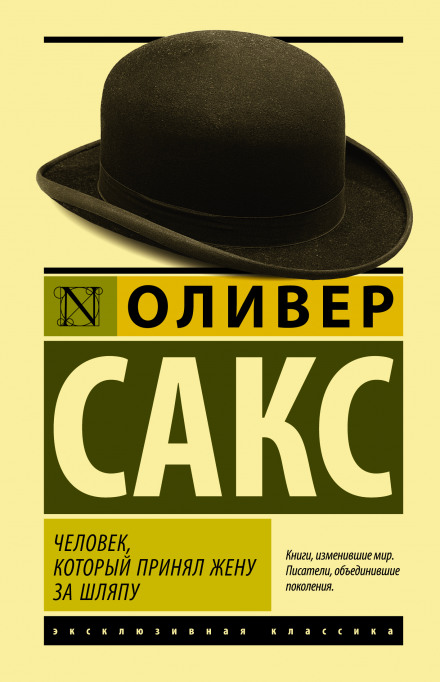
The Man Who Mistook His Wife for a Hat
9 hrs. 47 min.
Language
Russian
Author
Oliver Sacks
Author
Oliver Sacks
Narrator
Igor Knyazev
Narrator
Igor Knyazev
Description
Oliver Sacks is a well-known British neurologist and neuropsychologist, author of a number of popular books translated into twenty languages, two of which—“The Man Who Mistook His Wife for a Hat” and “An Anthropologist on Mars”—became international bestsellers.
“The Man Who Mistook His Wife for a Hat,” written by Oliver Sacks back in 1971 and since then reissued about ten times even only in English, not to mention numerous translations, is a set of stories about contemporary people struggling to overcome serious and unusual mental disorders and fighting to survive in circumstances completely unthinkable for healthy people—and about the mysteries of the past, obsessed with visions that modern science confidently diagnoses as severe neuroses. The strange, hard-to-grasp relationship between brain and consciousness is explained by Sacks in an accessible, vivid, and interesting way.
From the performer: Perhaps, for now, this is the most interesting of the popular science books I’ve recorded. For one thing, it deals with one of the most urgent mysteries of nature: how our consciousness works. And in this incredibly delicate work there can be malfunctions—what malfunctions! We can hardly even imagine that such things often occur. Perception disorders—both lack and excess—in our five senses. Loss of a sense of balance. Epilepsy, and how it is akin to heroin. The phenomenal abilities of savants, and so on. All of this is interesting on its own.
But, secondly, and maybe even foremost, it’s written very vividly, not boring at all, and with sincere interest and compassion for patients. And here we reach the third point: the author immediately states that he is a follower of the Soviet school of psychiatry, and in particular of Alexander Romanovich Luria, whose books inspired the author to create his international bestsellers. Against the background of the constant “Russian trail” in modern thrillers and detective stories, this warms the heart.
I’ll be glad to continue working with this humane writer—in every sense of the word.
“The Man Who Mistook His Wife for a Hat,” written by Oliver Sacks back in 1971 and since then reissued about ten times even only in English, not to mention numerous translations, is a set of stories about contemporary people struggling to overcome serious and unusual mental disorders and fighting to survive in circumstances completely unthinkable for healthy people—and about the mysteries of the past, obsessed with visions that modern science confidently diagnoses as severe neuroses. The strange, hard-to-grasp relationship between brain and consciousness is explained by Sacks in an accessible, vivid, and interesting way.
From the performer: Perhaps, for now, this is the most interesting of the popular science books I’ve recorded. For one thing, it deals with one of the most urgent mysteries of nature: how our consciousness works. And in this incredibly delicate work there can be malfunctions—what malfunctions! We can hardly even imagine that such things often occur. Perception disorders—both lack and excess—in our five senses. Loss of a sense of balance. Epilepsy, and how it is akin to heroin. The phenomenal abilities of savants, and so on. All of this is interesting on its own.
But, secondly, and maybe even foremost, it’s written very vividly, not boring at all, and with sincere interest and compassion for patients. And here we reach the third point: the author immediately states that he is a follower of the Soviet school of psychiatry, and in particular of Alexander Romanovich Luria, whose books inspired the author to create his international bestsellers. Against the background of the constant “Russian trail” in modern thrillers and detective stories, this warms the heart.
I’ll be glad to continue working with this humane writer—in every sense of the word.
