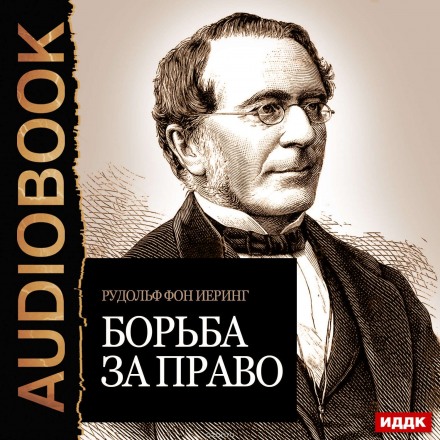
The Struggle for Law
3 hrs. 24 min.
Language
Russian
Author
Rudolf von Jhering
Author
Rudolf von Jhering
Narrator
Vadim Pugachev
Narrator
Vadim Pugachev
Description
The edition contains the famous monograph “The Struggle for Right” by the German jurist Rudolf von Jhering. Jhering sought to combine political-legal theories with sociological, psychological, and other concepts. The book sheds bright light on all life and legal relationships.
Rudolf von Jhering: “From the moment when the law gives up its willingness to fight, it must give up itself.”
Preface.
In the spring of 1872 I delivered a lecture to a legal society in Vienna, which I published in the summer of the same year under a substantially expanded version intended for a wider circle of readers, under the title “The Struggle for Right” (Der Kampf um’s Recht). The goal that guided me in creating and publishing this work was, above all, not so much theoretical as ethical-practical—aimed not at advancing scholarly knowledge of law, but at fostering the attitude from which law draws its final strength: the mood of courageous and persistent manifestation of the feeling of law.
The subsequent editions that this small work has survived serve as proof to me that its first success was due not to the charm of novelty, but to the conviction of the broad public in the correctness of the basic view defended in it. This conclusion is also strengthened for me by evidence from other countries, reflected in the extremely large number of translations of this work.
In later editions I retained the earlier opening, because it expressed a thought that, despite the modest amount of space allotted to it, seemed not entirely clear. I do not know whether, when distributing this work among non-specialists, I should not have omitted all those parts that are directed more at lawyers than at laymen—especially the concluding section on Roman law and its modern theory (pp. 58ff.). If I had been able to foresee the popularity this work won, I would have given it a different form from the start. But since it originates in a lecture delivered to jurists, the work is—according to its original purpose—intended primarily for the latter, and I did not think it necessary to change anything, because this circumstance turned out not to be an obstacle to its dissemination among non-specialists.
Rudolf von Jhering: “From the moment when the law gives up its willingness to fight, it must give up itself.”
Preface.
In the spring of 1872 I delivered a lecture to a legal society in Vienna, which I published in the summer of the same year under a substantially expanded version intended for a wider circle of readers, under the title “The Struggle for Right” (Der Kampf um’s Recht). The goal that guided me in creating and publishing this work was, above all, not so much theoretical as ethical-practical—aimed not at advancing scholarly knowledge of law, but at fostering the attitude from which law draws its final strength: the mood of courageous and persistent manifestation of the feeling of law.
The subsequent editions that this small work has survived serve as proof to me that its first success was due not to the charm of novelty, but to the conviction of the broad public in the correctness of the basic view defended in it. This conclusion is also strengthened for me by evidence from other countries, reflected in the extremely large number of translations of this work.
In later editions I retained the earlier opening, because it expressed a thought that, despite the modest amount of space allotted to it, seemed not entirely clear. I do not know whether, when distributing this work among non-specialists, I should not have omitted all those parts that are directed more at lawyers than at laymen—especially the concluding section on Roman law and its modern theory (pp. 58ff.). If I had been able to foresee the popularity this work won, I would have given it a different form from the start. But since it originates in a lecture delivered to jurists, the work is—according to its original purpose—intended primarily for the latter, and I did not think it necessary to change anything, because this circumstance turned out not to be an obstacle to its dissemination among non-specialists.
