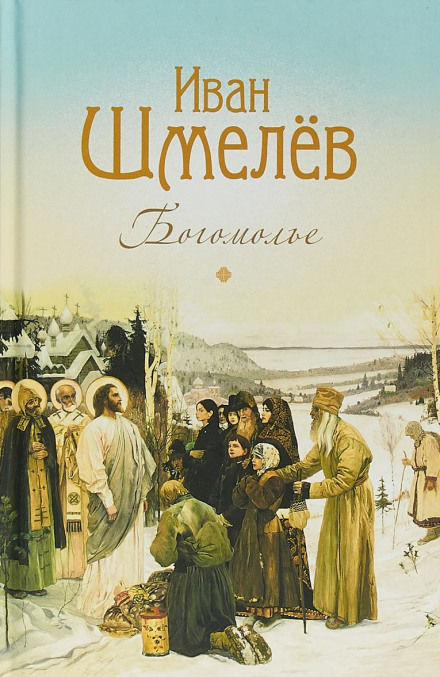
Pilgrimage
6 hrs. 35 min.
Language
Russian
Author
Ivan Shmelyov
Author
Ivan Shmelyov
Narrator
Vyacheslav Gerasimov
Narrator
Vyacheslav Gerasimov
Description
“The Pilgrimage” is probably not as well-known a work by Ivan Sergeyevich Shmelev as “Summer of the Lord.” The books were written while the writer lived in emigration in France. Shmelev had a nephew—whom the writer tried to tell what church holidays are, how they were celebrated in Russia, to show the life of prerevolutionary Russia through a child’s eyes, recalling his own childhood. That’s how the essays came about: they were originally published in one of the newspapers, and later issued as a separate book. The books were well received and highly praised by the Russian émigré community. For example, Konstantin Balmont treated them as bedside reading, and his opponent, Zinaida Gippius, after reading them wrote to Shmelev: “Only your soul could grasp all this and bring it all back.” “The Pilgrimage” is not a continuation, but rather an addition to “Summer of the Lord.” It was written fairly quickly, and here Ivan Sergeyevich recalls his pilgrimage to the Trinity-Sergius Lavra. The book begins with the old carpenter Gorkin—who “no longer works, he’s just around the house”—but in essence he is Vanya’s spiritual mentor—deciding to go to the Lavra to venerate the relics of Saint Sergius of Radonezh. Together with him, several more people leave Moscow: the coachman Antip; the merchant’s son Fyodor, secretly dreaming of becoming a monk; and for permission, they need a blessing from the elder—a matter to be asked of the old woman who runs the bathhouse, Domna Panferovna, “a prayerful and thorough woman,” and her granddaughter Anyuta. Along with Gorkin, father also lets Vanya go, who at that time was about 6–7. The journey to Sergiev Posad, new acquaintances, and the fates of the heroes are told from the perspective of a child.
100%
35:51
01 Царский золотой
25:44
02 Сборы
27:47
03 Москвой
29:02
04 Богомольный садик
28:33
05 На святой дороге (Part 1)
28:04
06 На святой дороге (Part 2)
32:59
07 У креста
24:57
08 Под Троицей
30:17
09 У Троицы на Посаде
43:04
10 У Преподобного
40:20
11 У Троицы
48:51
12 Благословение
