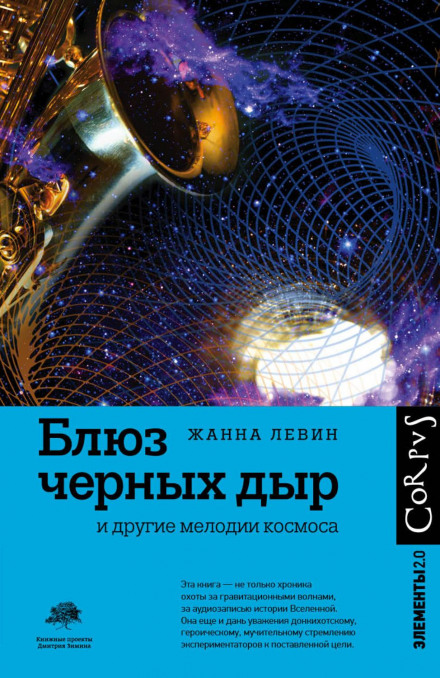
Black Hole Blues and Other Songs from Outer Space
7 hrs. 42 min.
Language
Russian
Author
Zhanna Levin
Author
Zhanna Levin
Narrator
Maxim Suslov
Narrator
Maxim Suslov
Description
The LIGO project became one of the most expensive and ambitious scientific projects of the past decades and brought its creators the 2017 Nobel Prize. The discovery made within this project is hard to overestimate. For the first time, humans were able to “hear” the cosmos. We managed to “catch” a gravitational wave created by the merging of two black holes.
Jeanne Levin, one of the most active participants in the LIGO project, tells how scientists from different parts of the Earth tried to do what, as countless skeptics insisted, was impossible: they detected a gravitational wave that traveled to us for billions of years, swept past in a fraction of a moment, and forever changed our history.
We heard the cosmos!
“Black Hole Blues and Other Cosmic Melodies” is a detailed and fascinating account of one of the most grandiose scientific discoveries of the 21st century. The merger of two black holes is perhaps the most incredible and majestic event imaginable in the boundless universe. When they merge, these two cosmic bodies release energy—more than a trillion times greater than the energy of a billion suns. And no human being, no telescope will be able to see it. Because no quantum of light can overcome the gravity of a black hole and escape its boundaries.
What’s more, we won’t be able to “hear” it in the way we hear any other cosmic event: sound waves don’t propagate in a vacuum. And yet… the fusion of black holes produces gravitational waves that compress and stretch space. Gravitational waves resemble sound vibrations, but to “sound” they don’t need a material medium. If we could learn to register these waves, we would hear not only how the merger of black holes sounds—we would hear how space-time itself sounds. The Universe would speak to us.
And in 2015, an event occurred whose importance can hardly be overstated. The LIGO project, one of the most expensive and ambitious in modern science, delivered results. We managed to “catch” the gravitational wave. We heard the cosmos. Jeanne Levin, one of the key scientists of this project, tells how the incredible became possible—and where it will lead us next.
Jeanne Levin, one of the most active participants in the LIGO project, tells how scientists from different parts of the Earth tried to do what, as countless skeptics insisted, was impossible: they detected a gravitational wave that traveled to us for billions of years, swept past in a fraction of a moment, and forever changed our history.
We heard the cosmos!
“Black Hole Blues and Other Cosmic Melodies” is a detailed and fascinating account of one of the most grandiose scientific discoveries of the 21st century. The merger of two black holes is perhaps the most incredible and majestic event imaginable in the boundless universe. When they merge, these two cosmic bodies release energy—more than a trillion times greater than the energy of a billion suns. And no human being, no telescope will be able to see it. Because no quantum of light can overcome the gravity of a black hole and escape its boundaries.
What’s more, we won’t be able to “hear” it in the way we hear any other cosmic event: sound waves don’t propagate in a vacuum. And yet… the fusion of black holes produces gravitational waves that compress and stretch space. Gravitational waves resemble sound vibrations, but to “sound” they don’t need a material medium. If we could learn to register these waves, we would hear not only how the merger of black holes sounds—we would hear how space-time itself sounds. The Universe would speak to us.
And in 2015, an event occurred whose importance can hardly be overstated. The LIGO project, one of the most expensive and ambitious in modern science, delivered results. We managed to “catch” the gravitational wave. We heard the cosmos. Jeanne Levin, one of the key scientists of this project, tells how the incredible became possible—and where it will lead us next.
100%
05:53
Блюз черных дыр и другие мелодии космоса - 0 - Предисловие научного редактора
08:23
Блюз черных дыр и другие мелодии космоса - 1 - Глава 1. Когда сталкиваются черные дыры
39:42
Блюз черных дыр и другие мелодии космоса - 2 - Глава 2. Рай Вайсс
39:38
Блюз черных дыр и другие мелодии космоса - 3 - Глава 3. Кип Торн
31:22
Блюз черных дыр и другие мелодии космоса - 4 - Глава 4. Рон Древер
26:15
Блюз черных дыр и другие мелодии космоса - 5 - Глава 5. Джо Вебер
21:34
Блюз черных дыр и другие мелодии космоса - 6 - Глава 6. Прототипы
27:30
Блюз черных дыр и другие мелодии космоса - 7 - Глава 7. “Тройка”
23:47
Блюз черных дыр и другие мелодии космоса - 8 - Глава 8. Джоселин Белл Бёрнелл
21:36
Блюз черных дыр и другие мелодии космоса - 9 - Глава 9. Вебер и Тримбл
31:07
Блюз черных дыр и другие мелодии космоса - 10 - Глава 10. LHO
39:16
Блюз черных дыр и другие мелодии космоса - 11 - Глава 11. “Сканк уоркс”
27:01
Блюз черных дыр и другие мелодии космоса - 12 - Глава 12. Пари
26:44
Блюз черных дыр и другие мелодии космоса - 13 - Глава 13. Расёмон
35:57
Блюз черных дыр и другие мелодии космоса - 14 - Глава 14. LLO
22:12
Блюз черных дыр и другие мелодии космоса - 15 - Глава 15. “Пещерка” на улице Фигероа
17:53
Блюз черных дыр и другие мелодии космоса - 16 - Глава 16. В ожидании волн
16:18
Блюз черных дыр и другие мелодии космоса - 17 - Эпилог
