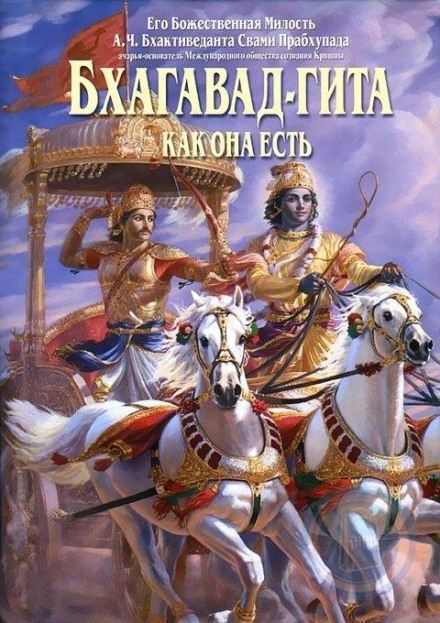
Bhagavad Gita As It Is
35 hrs. 26 min.
Language
Russian
Description
The book was first written 5,000 years ago.
At the time of publication of this book in 1966, there were already about 600 English translations of the "Bhagavad-Gita." Therefore Bhaktivedanta Swami named his translation with commentary "Bhagavad-Gita As It Is," explaining that all previous translations did not reflect the true meaning of this narrative because their authors do not belong to the chain of spiritual teachers.
…"The Beginning of the Battle on Kurukshetra"
The Bhagavad Gita ends with Sanjaya’s reassurance: “Where Krishna, the Lord of mystics, and Arjuna, the best of archers, are, there also is prosperity, victory, unprecedented might, and righteousness.”
The Gita begins with a question from King Dhritarashtra. He hoped for victory of his sons, on whose side stood great warriors Bhishma, Drona, and Karna. But Sanjaya says that, in his opinion, victory will be for Krishna and the Pandavas.
That Krishna took on the role of Arjuna’s charioteer is an expression of His detachment—one of His six opulences.
Everything starts with the tense relations between Duryodhana and Yudhishthira. Arjuna fights on the side of his elder brother, Yudhishthira. The battle decides who will rule the world, and Sanjaya predicts it will be Yudhishthira because he was also a very righteous ruler—over his whole life he never lied even once.
Many superficial commentators mistake the Bhagavad Gita for an ordinary dialogue between friends before a fight. But such a book could not become sacred scripture. One might argue that it was immoral for Krishna to urge Arjuna to fight—but in the Gita itself it is clearly stated that the Bhagavad Gita is the highest instruction about morality. The essence is laid out in the 34th verse of the Ninth Chapter: “Become a devotee of Krishna.” The meaning of religion is to surrender to Krishna. The Gita’s instructions are the highest process of religion and morality. All other processes can purify and lead to this process.”
At the time of publication of this book in 1966, there were already about 600 English translations of the "Bhagavad-Gita." Therefore Bhaktivedanta Swami named his translation with commentary "Bhagavad-Gita As It Is," explaining that all previous translations did not reflect the true meaning of this narrative because their authors do not belong to the chain of spiritual teachers.
…"The Beginning of the Battle on Kurukshetra"
The Bhagavad Gita ends with Sanjaya’s reassurance: “Where Krishna, the Lord of mystics, and Arjuna, the best of archers, are, there also is prosperity, victory, unprecedented might, and righteousness.”
The Gita begins with a question from King Dhritarashtra. He hoped for victory of his sons, on whose side stood great warriors Bhishma, Drona, and Karna. But Sanjaya says that, in his opinion, victory will be for Krishna and the Pandavas.
That Krishna took on the role of Arjuna’s charioteer is an expression of His detachment—one of His six opulences.
Everything starts with the tense relations between Duryodhana and Yudhishthira. Arjuna fights on the side of his elder brother, Yudhishthira. The battle decides who will rule the world, and Sanjaya predicts it will be Yudhishthira because he was also a very righteous ruler—over his whole life he never lied even once.
Many superficial commentators mistake the Bhagavad Gita for an ordinary dialogue between friends before a fight. But such a book could not become sacred scripture. One might argue that it was immoral for Krishna to urge Arjuna to fight—but in the Gita itself it is clearly stated that the Bhagavad Gita is the highest instruction about morality. The essence is laid out in the 34th verse of the Ninth Chapter: “Become a devotee of Krishna.” The meaning of religion is to surrender to Krishna. The Gita’s instructions are the highest process of religion and morality. All other processes can purify and lead to this process.”
100%
1:06:00
bg-ch01
50:06
bg-ch02-text-1-15
51:09
bg-ch02-text-15-30
52:33
bg-ch02-text-31-50
50:18
bg-ch02-text-50-72
51:40
bg-ch03-text-1-19
1:02:10
bg-ch03-text-20-43
1:10:00
bg-ch04-text-1-15
1:09:26
bg-ch04-text-16-42
1:23:18
bg-ch05
1:06:27
bg-ch06-text-1-25
1:07:32
bg-ch06-text-26-47
1:30:55
bg-ch07-text-1-15
1:02:16
bg-ch07-text-16-30
1:25:06
bg-ch08
1:09:53
bg-ch09-text-1-12
1:16:07
bg-ch09-text-13-34
1:08:39
bg-ch10-text-1-15
1:04:29
bg-ch10-text-16-37
1:00:24
bg-ch11-text-1-37
1:05:28
bg-ch11-text-38-55
1:01:07
bg-ch12
1:03:01
bg-ch13-text-1-15
1:00:15
bg-ch13-text-16-35
1:16:02
bg-ch14
1:17:40
bg-ch15
1:19:56
bg-ch16
1:00:59
bg-ch17
1:28:44
bg-ch18-text-1-50
1:19:31
bg-ch18-text-51-78
49:01
bg-introduction-1
55:05
bg-introduction-2
