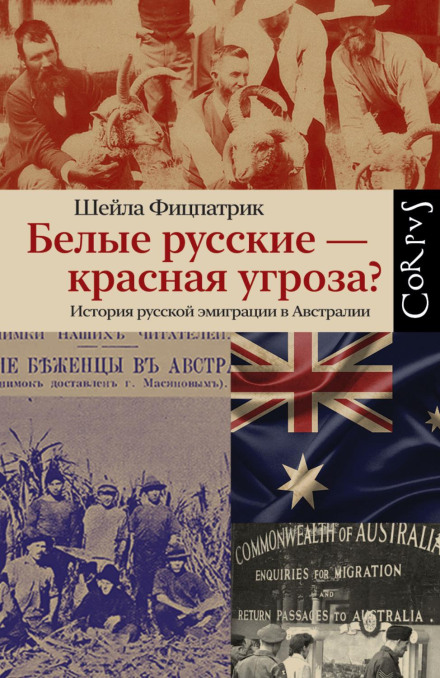
White Russians, Red Threat?
17 hrs. 8 min.
Language
Russian
Author
Sheila Fitzpatrick
Author
Sheila Fitzpatrick
Narrator
Irina Bulekova
Narrator
Irina Bulekova
Description
The book by the well-known expert and adviser Sheila Fitzpatrick sheds light on a little-known chapter of history: the migration of more than 20,000 ethnic Russians to Australia after World War II in search of a better life.
The author describes in detail the first years of the Russian-Australian community’s existence, as well as the influence of Australian and Soviet special services on its life.
“Russians in Australia”—this unusual topic is the focus of a new work by the well-known Australian and American historian Sheila Fitzpatrick. After World War II, the Green Continent became a new home for thousands of displaced persons—people scattered across Europe during the war, who for different reasons did not want to return home to the USSR. In turn, Australian authorities sought to solve the country’s shortage of workers, so the cooperation, while not cloudless or ideal, was nonetheless mutually beneficial: thousands of people boarded steamships to set off for a new life.
A second wave of Russian immigrants poured in from Manchuria, where an extensive Russian diaspora had already lived for several decades, formed during the construction of the Chinese Eastern Railway (CER).
But after Chinese communists came to power, Russians were forced to leave their settled places, and Australia became a new home for many of them.
These journeys were full of dramatic events, at times even detective-like twists, when even “the most ordinary person with a high probability could tell the most extraordinary story of their wandering.”
The author describes in detail the first years of the Russian-Australian community’s existence, as well as the influence of Australian and Soviet special services on its life.
“Russians in Australia”—this unusual topic is the focus of a new work by the well-known Australian and American historian Sheila Fitzpatrick. After World War II, the Green Continent became a new home for thousands of displaced persons—people scattered across Europe during the war, who for different reasons did not want to return home to the USSR. In turn, Australian authorities sought to solve the country’s shortage of workers, so the cooperation, while not cloudless or ideal, was nonetheless mutually beneficial: thousands of people boarded steamships to set off for a new life.
A second wave of Russian immigrants poured in from Manchuria, where an extensive Russian diaspora had already lived for several decades, formed during the construction of the Chinese Eastern Railway (CER).
But after Chinese communists came to power, Russians were forced to leave their settled places, and Australia became a new home for many of them.
These journeys were full of dramatic events, at times even detective-like twists, when even “the most ordinary person with a high probability could tell the most extraordinary story of their wandering.”
100%
18:42
01_01
09:53
01_02
13:36
01_03
08:23
01_04
08:53
01_05
12:51
01_06
09:50
01_07
18:00
02_01
08:45
02_02
08:32
02_03
18:32
02_04
09:02
02_05
25:20
02_06
09:00
02_07
09:04
03_01
21:56
03_02
09:21
03_03
16:31
03_04
08:59
03_05
12:11
03_06
14:11
03_07
10:33
04_01
09:00
04_02
18:42
04_03
08:47
04_04
09:18
04_05
12:12
04_06
09:53
04_07
18:52
04_08
07:57
05_01
13:05
05_02
11:50
05_03
08:22
05_04
10:55
05_05
11:29
05_06
08:08
05_07
12:57
05_08
08:12
05_09
11:50
06_01
09:04
06_02
13:12
06_03
26:05
06_04
10:51
06_05
13:54
06_06
13:55
06_07
17:12
07_01
12:01
07_02
11:16
07_03
08:15
07_04
15:52
07_05
15:47
07_06
07:59
07_07
08:35
08_01
08:03
08_02
22:20
08_03
10:00
08_04
10:11
08_05
12:49
08_06
16:53
08_07
07:51
08_08
08:03
09_01
15:10
09_02
08:24
09_03
18:34
09_04
22:22
09_05
21:05
09_06
09:47
10_01
08:22
10_02
09:16
10_03
08:59
10_04
17:56
10_05
10:10
10_06
29:43
10_07
40:30
11_01
13:40
11_02
09:37
11_03
30:54
11_04
