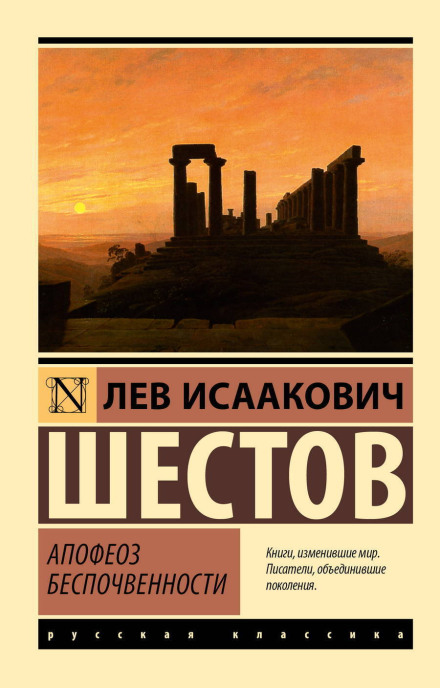
All Things Are Possible
5 hrs. 58 min.
Language
Russian
Author
Shestov Lev
Author
Shestov Lev
Narrator
Konstantin Korolkov
Narrator
Konstantin Korolkov
Description
Are you inclined to trust science, morality, and “common truths” more than your own inner sense?
Relying on the experience of Dostoevsky and Nietzsche, Lev Shestov created a book that immediately marked him as a thinker of a new era.
Lev Isaakovich Shestov (1866–1938) was a Russian philosopher, writer, and literary historian; his worldview was shaped under the strong influence of Dostoevsky and Nietzsche.
He belonged to the circle of the leading European intellectuals of his time: he was in contact with E. Husserl, C. Lévi-Strauss, M. Scheler, and M. Heidegger.
“ The Apotheosis of Groundlessness (An Essay on Adogmatic Thinking)” was published in 1905 and sparked heated debates in Moscow and St. Petersburg—from enthusiastic acceptance to sharp rejection.
It was this book that became Shestov’s philosophical manifesto: in it, he reflects on the limits of scientific knowledge, doubts the value of universal ideas and closed systems, rejects formal morality and “common” norms that substitute for living reality and prevent us from seeing it in all its richness and variety.
Relying on the experience of Dostoevsky and Nietzsche, Lev Shestov created a book that immediately marked him as a thinker of a new era.
Lev Isaakovich Shestov (1866–1938) was a Russian philosopher, writer, and literary historian; his worldview was shaped under the strong influence of Dostoevsky and Nietzsche.
He belonged to the circle of the leading European intellectuals of his time: he was in contact with E. Husserl, C. Lévi-Strauss, M. Scheler, and M. Heidegger.
“ The Apotheosis of Groundlessness (An Essay on Adogmatic Thinking)” was published in 1905 and sparked heated debates in Moscow and St. Petersburg—from enthusiastic acceptance to sharp rejection.
It was this book that became Shestov’s philosophical manifesto: in it, he reflects on the limits of scientific knowledge, doubts the value of universal ideas and closed systems, rejects formal morality and “common” norms that substitute for living reality and prevent us from seeing it in all its richness and variety.
100%
29:54
Апофеоз беспочвенности 01
2:17:24
Апофеоз беспочвенности 02
2:38:41
Апофеоз беспочвенности 03
32:28
Апофеоз беспочвенности 04
