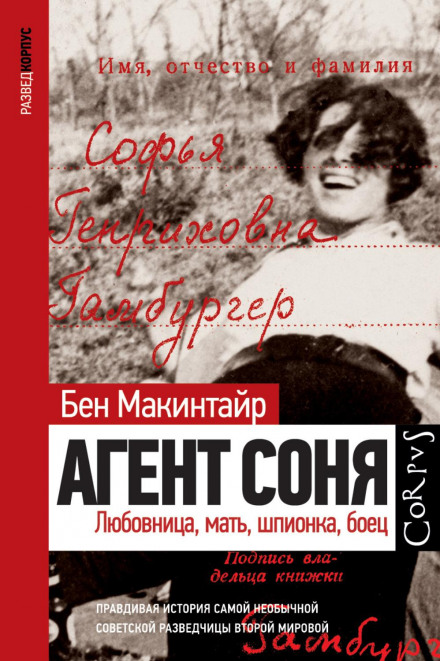
Agent Sonya: Lover, Mother, Spy, Soldier
14 hrs. 45 min.
Language
Russian
Author
Ben Macintyre
Author
Ben Macintyre
Narrator
Veronika Raytsiz
Narrator
Veronika Raytsiz
Description
By striking sixteen-year-old Urszula Kuchinsky with a club during a demonstration, a Berlin police officer—without knowing it—sealed her fate. The girl from an educated Jewish family, whose father and brother held leftist views, became a loyal supporter of communism and spent twenty years spying for the Soviet Union. Agent Sonya received her baptism of fire in Shanghai from Richard Sorge, went through an intelligence school in Moscow, nearly took part in an attempt on Hitler, personally assembled radio transmitters, and during World War II passed atomic secrets to the USSR that she obtained from the intelligence officer Klaus Fuchs—and she never once failed an assignment. Sociable and cheerful, she fell in love and raised children, cared for her parents—and gave the clumsy investigators of Mi-5 no reason to suspect her of a double life. The fate of Ursula Kuchinsky—Gam burger—Burton is an astonishing example of how one can stay faithful to one’s beliefs without betraying—or being betrayed—in a world seized by catastrophe, where black and white change places or merge into one. Perhaps her secret lies in the ability to love and change without losing herself.
100%
04:18
Агент Соня. Любовница, мать, шпионка, боец - 0 - Введение
52:49
Агент Соня. Любовница, мать, шпионка, боец - 1 - Глава 1. Ураган
45:11
Агент Соня. Любовница, мать, шпионка, боец - 2 - Глава 2. Восточная блудница
32:26
Агент Соня. Любовница, мать, шпионка, боец - 3 - Глава 3. Агент Рамзай
37:51
Агент Соня. Любовница, мать, шпионка, боец - 4 - Глава 4. Когда Соня пляшет
36:43
Агент Соня. Любовница, мать, шпионка, боец - 5 - Глава 5. Шпионы, которые ее любили
36:14
Агент Соня. Любовница, мать, шпионка, боец - 6 - Глава 6. Воробьевка
21:49
Агент Соня. Любовница, мать, шпионка, боец - 7 - Глава 7. На борту “Конте Верде”
26:57
Агент Соня. Любовница, мать, шпионка, боец - 8 - Глава 8. Наш человек в Маньчжурии
24:25
Агент Соня. Любовница, мать, шпионка, боец - 9 - Глава 9. Скитания
35:01
Агент Соня. Любовница, мать, шпионка, боец - 10 - Глава 10. Из Пекина в Польшу
43:06
Агент Соня. Любовница, мать, шпионка, боец - 11 - Глава 11. За английский пенни
48:15
Агент Соня. Любовница, мать, шпионка, боец - 12 - Глава 12. “Кротовый холм”
36:43
Агент Соня. Любовница, мать, шпионка, боец - 13 - Глава 13. Брак по расчету
33:17
Агент Соня. Любовница, мать, шпионка, боец - 14 - Глава 14. Похитительница
26:26
Агент Соня. Любовница, мать, шпионка, боец - 15 - Глава 15. Счастливое время
26:03
Агент Соня. Любовница, мать, шпионка, боец - 16 - Глава 16. Барбаросса
34:39
Агент Соня. Любовница, мать, шпионка, боец - 17 - Глава 17. Дорога в ад
40:05
Агент Соня. Любовница, мать, шпионка, боец - 18 - Глава 18. Атомные шпионы
26:50
Агент Соня. Любовница, мать, шпионка, боец - 19 - Глава 19. Милисент из МИ-5
43:12
Агент Соня. Любовница, мать, шпионка, боец - 20 - Глава 20. Операция “Молот”
29:31
Агент Соня. Любовница, мать, шпионка, боец - 21 - Глава 21. Шепот весны
40:52
Агент Соня. Любовница, мать, шпионка, боец - 22 - Глава 22. Грейт-Роллрайт
51:12
Агент Соня. Любовница, мать, шпионка, боец - 23 - Глава 23. Очень крепкий орешек
37:07
Агент Соня. Любовница, мать, шпионка, боец - 24 - Глава 24. Рут Вернер
14:55
Агент Соня. Любовница, мать, шпионка, боец - 25 - Послесловие. Жизнь других
