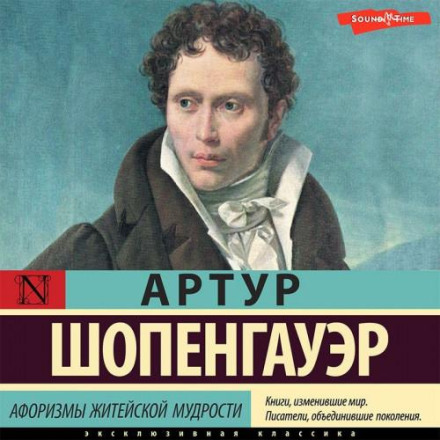
Aphorisms on the Wisdom of Life
9 hrs. 13 min.
Language
Russian
Author
Arthur Schopenhauer
Author
Arthur Schopenhauer
Narrator
Igor Gmyza
Narrator
Igor Gmyza
Description
"Aphorisms of Everyday Wisdom" is a work that contrasts its own ethical concept of the “philosopher of pessimism” with the Epicurean concept. The “Aphorisms” complement Schopenhauer’s opus magnum and help you better understand its meaning. “Aphorisms of Everyday Wisdom” were originally published in the first volume of the collection “Supplements and Omissions” — Schopenhauer’s last major work. The author chose the title as best as possible. In the work he reflects on how to “spend one’s life more pleasantly and happily.” And perhaps the recipe isn’t for everyone, but it’s hard not to agree with everyone given the sharp, merciless remarks.
• “Sometimes we think that we are longing for some distant place, while in reality we are longing for the time we spent there, when we were younger and more vigorous than now. That’s how time deceives us by wearing the mask of space.”
• “Wealth is like salt water: the more you drink, the stronger your thirst. This also applies to fame.”
• “Vanity makes a person talkative, while pride makes them silent.”
• “True self-respect makes us respond to an insult with complete indifference.”
• “Any intelligence will remain unnoticed by those who do not have it themselves.”
• “Very often — and apparently fairly — it is claimed that a person who is quite limited in intellectual matters is, in essence, the happiest, although no one would envy such happiness.”
• “In solitude, an insignificant person feels their own insignificance; a great mind — its greatness; in short, everyone sees in themselves what they truly are.”
• “Sometimes we think that we are longing for some distant place, while in reality we are longing for the time we spent there, when we were younger and more vigorous than now. That’s how time deceives us by wearing the mask of space.”
• “Wealth is like salt water: the more you drink, the stronger your thirst. This also applies to fame.”
• “Vanity makes a person talkative, while pride makes them silent.”
• “True self-respect makes us respond to an insult with complete indifference.”
• “Any intelligence will remain unnoticed by those who do not have it themselves.”
• “Very often — and apparently fairly — it is claimed that a person who is quite limited in intellectual matters is, in essence, the happiest, although no one would envy such happiness.”
• “In solitude, an insignificant person feels their own insignificance; a great mind — its greatness; in short, everyone sees in themselves what they truly are.”
