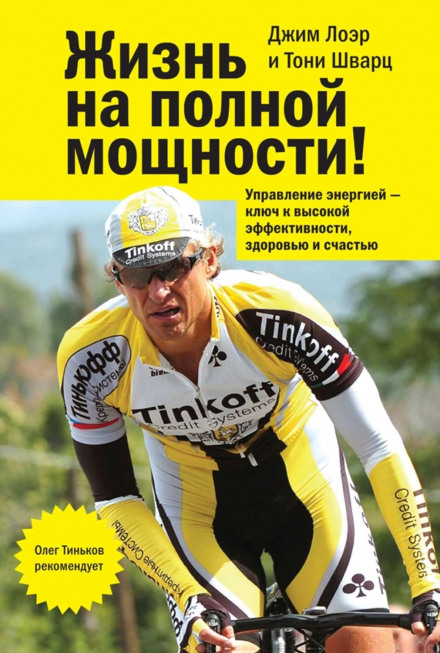
The Power of Full Engagement!
4 hrs. 11 min.
Language
Russian
Author
Jim Loehr
Author
Tony Schwartz
Narrator
Dmitry Kreminsky
Narrator
Dmitry Kreminsky
Description
The Power of Full Engagement. Managing Energy Is the Key to High Performance, Health, and Happiness.
Time management is a wonderful invention. It helps us set more significant goals, accomplish more at work, and earn a higher income. Books on this topic typically offer advice like "come to work an hour earlier and leave an hour later — you'll be amazed at how much more you get done." But somehow this scheme breaks down. Many tasks are planned, yet there isn't enough energy to get through even half of them. To keep up with everything, you come home later and later, and your family and friendship bonds begin to fray. Poor diet and stress lead to illness. What can you do? Give up your ambitions? Or try to find a new source of energy?
The answer came from the world of professional sports. The authors of The Power of Full Engagement spent many years working on the psychological preparation of top tennis stars. They sought the answer to the question: why do two athletes have the same skills, yet one consistently beats the other? What is the secret? It turned out that the winner knows how to relax instantly between serves, while his opponent remains tense throughout the entire match. After a while, his ability to concentrate drops, his strength fades, and he inevitably loses.
The same thing happens with corporate employees. Monotonous workloads lead to exhaustion and physical ailments. To prevent this, we need to learn to manage our energy — physical, emotional, mental, and spiritual. The principles and methods described in the book explain how to do this.
Who is this book for?
For everyone who works hard, sets professional and personal goals, and makes daily efforts to achieve them.
The book's special feature
The authors spent many years working on the psychological preparation of world sports stars, including tennis players Pete Sampras, Jim Courier, Arantxa Sánchez, Sergi Bruguera, Gabriela Sabatini, and Monica Seles; golfers Mark O'Meara and Ernie Els; hockey players Eric Lindros and Mike Richter; boxer Ray "Boom Boom" Mancini; basketball players Nick Anderson and Grant Hill; and speed skater Dan Jansen.
From the author
"Many of us live life like an endless marathon, constantly pushing ourselves to extreme and health-threatening limits. We turn ourselves into mental and emotional pack horses, continuously expending energy without adequately restoring it.
We must learn to live our years as a series of sprints — periods of full engagement alternating with episodes of genuine rest and recovery."
Time management is a wonderful invention. It helps us set more significant goals, accomplish more at work, and earn a higher income. Books on this topic typically offer advice like "come to work an hour earlier and leave an hour later — you'll be amazed at how much more you get done." But somehow this scheme breaks down. Many tasks are planned, yet there isn't enough energy to get through even half of them. To keep up with everything, you come home later and later, and your family and friendship bonds begin to fray. Poor diet and stress lead to illness. What can you do? Give up your ambitions? Or try to find a new source of energy?
The answer came from the world of professional sports. The authors of The Power of Full Engagement spent many years working on the psychological preparation of top tennis stars. They sought the answer to the question: why do two athletes have the same skills, yet one consistently beats the other? What is the secret? It turned out that the winner knows how to relax instantly between serves, while his opponent remains tense throughout the entire match. After a while, his ability to concentrate drops, his strength fades, and he inevitably loses.
The same thing happens with corporate employees. Monotonous workloads lead to exhaustion and physical ailments. To prevent this, we need to learn to manage our energy — physical, emotional, mental, and spiritual. The principles and methods described in the book explain how to do this.
Who is this book for?
For everyone who works hard, sets professional and personal goals, and makes daily efforts to achieve them.
The book's special feature
The authors spent many years working on the psychological preparation of world sports stars, including tennis players Pete Sampras, Jim Courier, Arantxa Sánchez, Sergi Bruguera, Gabriela Sabatini, and Monica Seles; golfers Mark O'Meara and Ernie Els; hockey players Eric Lindros and Mike Richter; boxer Ray "Boom Boom" Mancini; basketball players Nick Anderson and Grant Hill; and speed skater Dan Jansen.
From the author
"Many of us live life like an endless marathon, constantly pushing ourselves to extreme and health-threatening limits. We turn ourselves into mental and emotional pack horses, continuously expending energy without adequately restoring it.
We must learn to live our years as a series of sprints — periods of full engagement alternating with episodes of genuine rest and recovery."
100%
33:42
01-glava-1-na-polnoy-moschnosti
18:31
02-glava-2-zhizn-rodzhera-b-poterya-moschnosti
44:55
03-glava-3-pulsaciya-vysokoy-effektivnosti
26:50
04-glava-4-fizicheskaya-energiya
14:00
05-glava-5-emocionalnaya-energiya
15:27
06-glava-6-umstvennaya-energiya
14:49
07-glava-7-duhovnaya-energiya
23:31
08-glava-8-opredelenie-celi
31:37
09-glava-9-vzglyanite-pravde-v-glaza
28:27
10-glava-10-perehodim-k-deystviyu
