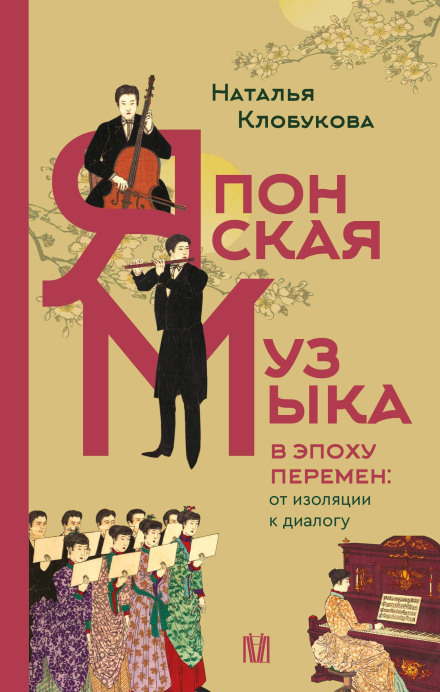
Japanese Music in an Era of Change: From Isolation to Dialogue
10 hrs. 36 min.
Language
Russian
Author
Natalia Klobukova
Author
Natalia Klobukova
Narrator
Natalia Klobukova
Narrator
Natalia Klobukova
Description
At a time when Japan was trying to combine openness to the world with fidelity to its own tradition, music became one of the key ways to meet this challenge. In this book by Japanologist Natalya Klobukova, readers will find the historical experience of tolerance and flexibility—one that will resonate with anyone, regardless of their interests or profession.
How Western music turned into a tool of diplomacy, education, military policy, and Christian missions—from marches and school songs to church hymns.
Natalya Klobukova’s research demonstrates in detail and at length how Western musical culture took root in Japan in the second half of the 19th century—during a period of rapid modernization under Emperor Meiji.
The Meiji era (1868–1912) became a time of difficult choices: how to adopt the new and yet not lose oneself? This question, faced by any country in the context of globalization, is especially understandable to Russian readers.
The author convincingly shows that music worked not only as art, but also as a practical instrument—in diplomacy, education, and even military strategy: from marching melodies and the school repertoire to devotional songs.
Against the backdrop of cultural debates and the search for “national sound,” the book offers an important lesson from history: Japan did not become a copy of the West—it thought through borrowings and processed them, creating a new, original cultural phenomenon. This is an inspiring example of how to be open to the world while preserving cultural identity.
A well-designed, illustrated edition makes an excellent gift and will appeal to everyone interested in the history and culture of Japan, as well as to musicians, students, and teachers in the humanities.
About the author
Natalya Fedorovna Klobukova is an ethnomusicologist and musician, Candidate of Cultural Studies, Associate Professor at the School of Oriental Studies, HSE University. She is the author of more than fifty works on traditional and contemporary Japanese music, published in Russia and abroad. A regular participant in academic conferences. She has given concerts and open lectures on the history of Japanese and Russian music in Russia, Japan, and European countries.
How Western music turned into a tool of diplomacy, education, military policy, and Christian missions—from marches and school songs to church hymns.
Natalya Klobukova’s research demonstrates in detail and at length how Western musical culture took root in Japan in the second half of the 19th century—during a period of rapid modernization under Emperor Meiji.
The Meiji era (1868–1912) became a time of difficult choices: how to adopt the new and yet not lose oneself? This question, faced by any country in the context of globalization, is especially understandable to Russian readers.
The author convincingly shows that music worked not only as art, but also as a practical instrument—in diplomacy, education, and even military strategy: from marching melodies and the school repertoire to devotional songs.
Against the backdrop of cultural debates and the search for “national sound,” the book offers an important lesson from history: Japan did not become a copy of the West—it thought through borrowings and processed them, creating a new, original cultural phenomenon. This is an inspiring example of how to be open to the world while preserving cultural identity.
A well-designed, illustrated edition makes an excellent gift and will appeal to everyone interested in the history and culture of Japan, as well as to musicians, students, and teachers in the humanities.
About the author
Natalya Fedorovna Klobukova is an ethnomusicologist and musician, Candidate of Cultural Studies, Associate Professor at the School of Oriental Studies, HSE University. She is the author of more than fifty works on traditional and contemporary Japanese music, published in Russia and abroad. A regular participant in academic conferences. She has given concerts and open lectures on the history of Japanese and Russian music in Russia, Japan, and European countries.
100%
18:29
Японская музыка в эпоху перемен: от изоляции к диалогу 01
1:12:27
Японская музыка в эпоху перемен: от изоляции к диалогу 02
2:39:15
Японская музыка в эпоху перемен: от изоляции к диалогу 03
3:04:27
Японская музыка в эпоху перемен: от изоляции к диалогу 04
2:53:10
Японская музыка в эпоху перемен: от изоляции к диалогу 05
28:35
Японская музыка в эпоху перемен: от изоляции к диалогу 06
