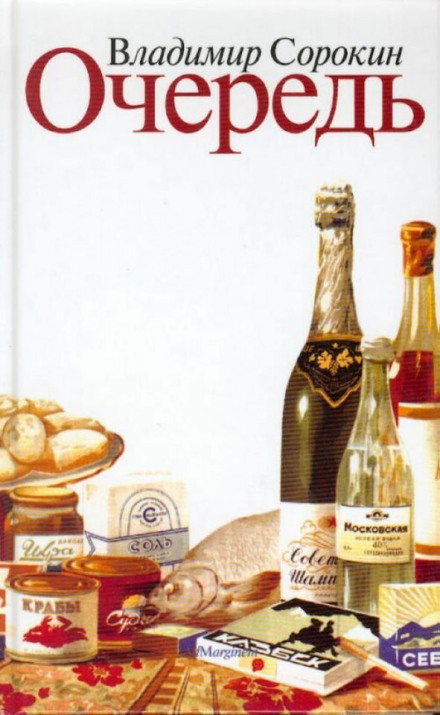
The Queue
4 hrs. 44 min.
Language
Russian
Author
Vladimir Sorokin
Author
Vladimir Sorokin
Narrator
Mikhail Gorevoy
Narrator
Mikhail Gorevoy
Description
A novel made entirely of direct speech—an endless line as a metaphor for human life in general.
Each remark adds a stroke to the portrait of the era, yet it hangs in the air; it belongs to everyone—and to no one.
The Soviet Union. In a huge queue stretching for many kilometers, representatives of different social groups, worldviews, and professions stand side by side. They stand who after whom; some even don’t know what exactly they brought, but if there’s a line, it means something valuable must be taken. Everyone is stirred by the same questions: is it imported or not, is there a lot of defective goods, which of the shopgirls serves faster, how much they’ll give to one person, and—most importantly—will it be enough for everyone?
Some try to push forward, others try to keep their place, someone steps away, someone returns. The entire novel consists of dialogues, shouts, suddenly caught phrases, quarrels, arguments, and people calling back to one another.
Life pours over in this queue: reflections on Yevtushenko’s poetry sit beside confessional stories about ruined happiness; invitations to go around the corner to drink “to brotherhood”—share-a-night—follow by a brutal brawl; and profanities go hand in hand with the kind of real, unfeigned love that, as it happens, saves the protagonist.
Each remark adds a stroke to the portrait of the era, yet it hangs in the air; it belongs to everyone—and to no one.
The Soviet Union. In a huge queue stretching for many kilometers, representatives of different social groups, worldviews, and professions stand side by side. They stand who after whom; some even don’t know what exactly they brought, but if there’s a line, it means something valuable must be taken. Everyone is stirred by the same questions: is it imported or not, is there a lot of defective goods, which of the shopgirls serves faster, how much they’ll give to one person, and—most importantly—will it be enough for everyone?
Some try to push forward, others try to keep their place, someone steps away, someone returns. The entire novel consists of dialogues, shouts, suddenly caught phrases, quarrels, arguments, and people calling back to one another.
Life pours over in this queue: reflections on Yevtushenko’s poetry sit beside confessional stories about ruined happiness; invitations to go around the corner to drink “to brotherhood”—share-a-night—follow by a brutal brawl; and profanities go hand in hand with the kind of real, unfeigned love that, as it happens, saves the protagonist.
100%
22:02
01_Ochered
31:10
02_Ochered
28:12
03_Ochered
20:56
04_Ochered
25:58
05_Ochered
14:48
06_Ochered
10:44
07_Ochered
25:47
08_Ochered
10:21
09_Ochered
15:39
10_Ochered
18:59
11_Ochered
28:10
12_Ochered
31:59
13_Ochered
