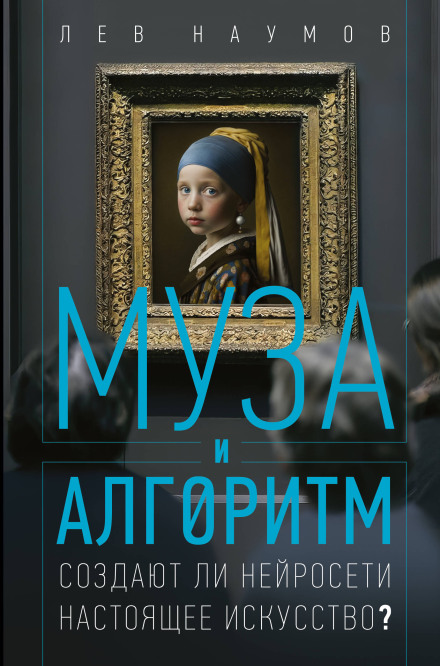
The Muse and the Algorithm: Do Neural Networks Create Real Art?
11 hrs. 20 min.
Language
Russian
Author
Lev Naumov
Author
Lev Naumov
Narrator
Vadim Prokhorov
Narrator
Vadim Prokhorov
Description
Can neural networks become artists and writers? In front of you is an intellectual study located at the border of art theory, philosophy, and the neurosciences. Its author is Lev Naumov, a writer, playwright, cultural scholar, and director, PhD, who gives lectures on literature, cinema, and the theory of art. He has written prose books “The Whisper of Forgotten Letters” (2014), “The DedaI Hypothesis” (2018), “The Dreamer” (2021), and is known for works about the creativity of Andrei Tarkovsky, Aleksandr Kaidanovsky, Samuel Beckett, Andy Warhol, Terry Gilliam, Christopher Nolan, Sergei Parajanov, David Lynch, and other cultural figures.
This book is not only analysis, but also a thought journey through digital aesthetics, the neurosciences, and the history of art. Drawing on philosophical ideas, visual case studies, and a lively conversational tone, the author leads a careful discussion about the nature of creativity: can it be described and algorithmized, and does the possibility of programming mean that creativity is no longer exclusively “human”? The book re-poses questions about how art is recognized today and where the boundaries are between the original and generation, between the authentic and the simulation.
Lev Naumov considers whether what is created by (or together with) neural networks can be truly unique, whether art itself isn’t “secondary,” and why these topics still remain blurred — like outlines on impressionists’ canvases. Even the fact that generative models prompt us to write about them and with them becomes a sign of synergy that could lead to progress and the reassembling of familiar forms (Ksenia Burzhskaya, prose writer, poet, AI-evangelist for the virtual assistant “Alice” at Yandex).
If, for centuries, thought was born through мучительные (painful) guiding questions, as Plato noted, then neural networks offer a different mechanism — almost a “Caesarean section”: the question is asked, and the answer is ready. Some will consider such an answer weak, others convincing, especially if judging it by the logic of Marcel Duchamp. The book discusses how we should relate to products of neural network writing and imagery: are we moving toward “neuro-classicism,” since large language models are still trained on texts created by humans, or, on the contrary, are we moving away from genuine creative experience (Polina Krivykh, psychophysiologist, neuroresearcher, CEO of Inhound).
Design: LLC “AST Publishing House,” 2025.
This book is not only analysis, but also a thought journey through digital aesthetics, the neurosciences, and the history of art. Drawing on philosophical ideas, visual case studies, and a lively conversational tone, the author leads a careful discussion about the nature of creativity: can it be described and algorithmized, and does the possibility of programming mean that creativity is no longer exclusively “human”? The book re-poses questions about how art is recognized today and where the boundaries are between the original and generation, between the authentic and the simulation.
Lev Naumov considers whether what is created by (or together with) neural networks can be truly unique, whether art itself isn’t “secondary,” and why these topics still remain blurred — like outlines on impressionists’ canvases. Even the fact that generative models prompt us to write about them and with them becomes a sign of synergy that could lead to progress and the reassembling of familiar forms (Ksenia Burzhskaya, prose writer, poet, AI-evangelist for the virtual assistant “Alice” at Yandex).
If, for centuries, thought was born through мучительные (painful) guiding questions, as Plato noted, then neural networks offer a different mechanism — almost a “Caesarean section”: the question is asked, and the answer is ready. Some will consider such an answer weak, others convincing, especially if judging it by the logic of Marcel Duchamp. The book discusses how we should relate to products of neural network writing and imagery: are we moving toward “neuro-classicism,” since large language models are still trained on texts created by humans, or, on the contrary, are we moving away from genuine creative experience (Polina Krivykh, psychophysiologist, neuroresearcher, CEO of Inhound).
Design: LLC “AST Publishing House,” 2025.
100%
30:25
Муза и алгоритм. Создают ли нейросети настоящее искусство? 01
43:39
Муза и алгоритм. Создают ли нейросети настоящее искусство? 02
59:12
Муза и алгоритм. Создают ли нейросети настоящее искусство? 03
59:38
Муза и алгоритм. Создают ли нейросети настоящее искусство? 04
36:01
Муза и алгоритм. Создают ли нейросети настоящее искусство? 05
40:30
Муза и алгоритм. Создают ли нейросети настоящее искусство? 06
38:32
Муза и алгоритм. Создают ли нейросети настоящее искусство? 07
30:28
Муза и алгоритм. Создают ли нейросети настоящее искусство? 08
21:27
Муза и алгоритм. Создают ли нейросети настоящее искусство? 09
13:16
Муза и алгоритм. Создают ли нейросети настоящее искусство? 10
34:11
Муза и алгоритм. Создают ли нейросети настоящее искусство? 11
31:10
Муза и алгоритм. Создают ли нейросети настоящее искусство? 12
21:24
Муза и алгоритм. Создают ли нейросети настоящее искусство? 13
36:02
Муза и алгоритм. Создают ли нейросети настоящее искусство? 14
17:48
Муза и алгоритм. Создают ли нейросети настоящее искусство? 15
58:55
Муза и алгоритм. Создают ли нейросети настоящее искусство? 16
28:15
Муза и алгоритм. Создают ли нейросети настоящее искусство? 17
45:30
Муза и алгоритм. Создают ли нейросети настоящее искусство? 18
21:15
Муза и алгоритм. Создают ли нейросети настоящее искусство? 19
12:22
Муза и алгоритм. Создают ли нейросети настоящее искусство? 20
