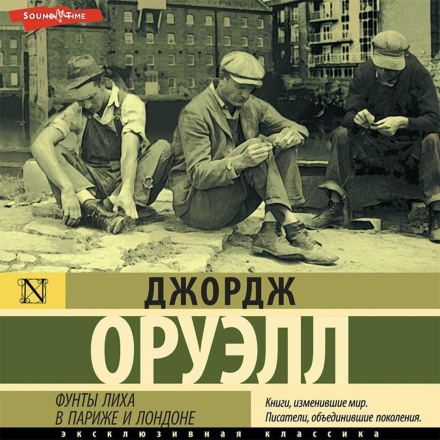
Down and Out in Paris and London
7 hrs. 20 min.
Language
Russian
Author
George Orwell
Author
George Orwell
Narrator
Ivan Litvinov
Narrator
Ivan Litvinov
Description
"When I sit down to write a book," Orwell once admitted, "I don’t tell myself, 'I want to create a work of art.' I write it because there is some lie that I must expose, some fact that needs to be brought to people’s attention…" This is exactly how the four autobiographical stories of Orwell that make up this book were written.
"It Was Great, Great Fun" is about childhood and schooling at St. Cyprian’s; Orwell said that he "transferred the sounds, smells, and colors of his school childhood" into the fantastical "London of 1984," and that the "suffering of students in English schools is an analogy for a person’s helplessness before totalitarian power." "Down and Out in Paris and London" is about the underside of life on the brilliant city’s back streets, where he worked as a dishwasher in a hotel, and about the world of London drifters and the poor among whom Orwell lived for three years, sleeping under bridges and in shelters for the homeless… "The Road to Wigan Pier" is about the north of England—both poetic and industrial—and about the hardships of miners, the working class, the "humiliated and insulted," whose suffering a socialist writer simply couldn’t remain indifferent to. Finally, "Homage to Catalonia"—perhaps one of his most scorching and honest texts—is about the civil war in Spain, where he went to fight as part of a militia.
"It Was Great, Great Fun" is about childhood and schooling at St. Cyprian’s; Orwell said that he "transferred the sounds, smells, and colors of his school childhood" into the fantastical "London of 1984," and that the "suffering of students in English schools is an analogy for a person’s helplessness before totalitarian power." "Down and Out in Paris and London" is about the underside of life on the brilliant city’s back streets, where he worked as a dishwasher in a hotel, and about the world of London drifters and the poor among whom Orwell lived for three years, sleeping under bridges and in shelters for the homeless… "The Road to Wigan Pier" is about the north of England—both poetic and industrial—and about the hardships of miners, the working class, the "humiliated and insulted," whose suffering a socialist writer simply couldn’t remain indifferent to. Finally, "Homage to Catalonia"—perhaps one of his most scorching and honest texts—is about the civil war in Spain, where he went to fight as part of a militia.
100%
10:10
Фунты лиха в Париже и Лондоне - 0 -
12:26
Фунты лиха в Париже и Лондоне - 1 -
10:27
Фунты лиха в Париже и Лондоне - 2 -
11:18
Фунты лиха в Париже и Лондоне - 3 -
11:30
Фунты лиха в Париже и Лондоне - 4 -
11:02
Фунты лиха в Париже и Лондоне - 5 -
15:19
Фунты лиха в Париже и Лондоне - 6 -
11:54
Фунты лиха в Париже и Лондоне - 7 -
09:07
Фунты лиха в Париже и Лондоне - 8 -
11:55
Фунты лиха в Париже и Лондоне - 9 -
12:10
Фунты лиха в Париже и Лондоне - 10 -
06:30
Фунты лиха в Париже и Лондоне - 11 -
10:52
Фунты лиха в Париже и Лондоне - 12 -
17:46
Фунты лиха в Париже и Лондоне - 13 -
09:32
Фунты лиха в Париже и Лондоне - 14 -
08:08
Фунты лиха в Париже и Лондоне - 15 -
10:14
Фунты лиха в Париже и Лондоне - 16 -
05:29
Фунты лиха в Париже и Лондоне - 17 -
12:09
Фунты лиха в Париже и Лондоне - 18 -
13:22
Фунты лиха в Париже и Лондоне - 19 -
08:41
Фунты лиха в Париже и Лондоне - 20 -
13:41
Фунты лиха в Париже и Лондоне - 21 -
08:18
Фунты лиха в Париже и Лондоне - 22 -
15:25
Фунты лиха в Париже и Лондоне - 23 -
12:22
Фунты лиха в Париже и Лондоне - 24 -
09:00
Фунты лиха в Париже и Лондоне - 25 -
14:18
Фунты лиха в Париже и Лондоне - 26 -
08:46
Фунты лиха в Париже и Лондоне - 27 -
16:21
Фунты лиха в Париже и Лондоне - 28 -
16:35
Фунты лиха в Париже и Лондоне - 29 -
14:12
Фунты лиха в Париже и Лондоне - 30 -
10:33
Фунты лиха в Париже и Лондоне - 31 -
15:48
Фунты лиха в Париже и Лондоне - 32 -
13:34
Фунты лиха в Париже и Лондоне - 33 -
13:47
Фунты лиха в Париже и Лондоне - 34 -
15:35
Фунты лиха в Париже и Лондоне - 35 -
09:29
Фунты лиха в Париже и Лондоне - 36 -
02:46
Фунты лиха в Париже и Лондоне - 37 -
