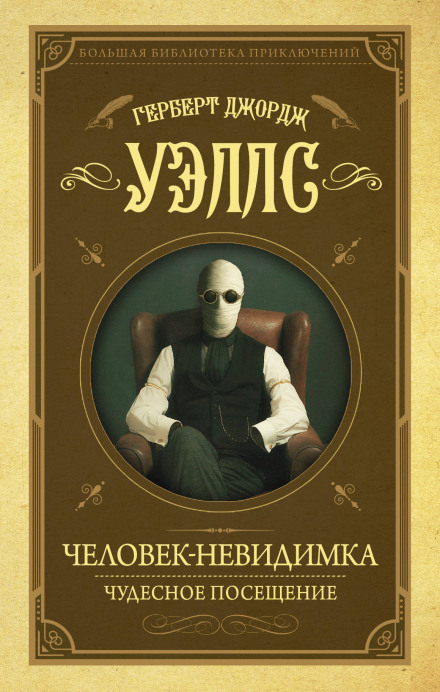
The Invisible Man
6 hrs. 17 min.
Language
Russian
Author
Herbert Wells
Author
Herbert Wells
Narrator
Alexander Khorlin
Narrator
Alexander Khorlin
Description
Every adult carries childish dreams in their soul about miracle abilities: flying, passing through walls, becoming unbelievably strong—or… invisible. Is it surprising that as soon as fiction was born, it behaved like a big child and rushed to fulfill its childish whims? But Herbert Wells wouldn’t be a classic of world literature if his goal were only to entertain the public. In his world, the Invisible Man won’t become a superhero or a super-spy. Here, an unrecognized genius turns into a wicked genius, and an adventure thriller becomes a satirical parable about bourgeois manners of “good old England” and a runaway Nietzschean “superman.” Yuri Olesha even believed that “The Invisible Man” was a disguised propaganda of anarchists.
Of course, Wells tried to keep the pseudo-scientific tone accepted in his time, but you don’t need to be a physicist to understand how far-fetched and fairy-tale-like Griffin’s experiments are. How could an invisible man see if his eyes didn’t absorb light? In any case, that’s a question for a stick-in-the-mud who can’t read fairy tales. And times were different.
In an attempt to portray all of English society at once and the novel’s colorful cast of characters, the reader Alexander Horlin tried to vary the intonation to play out every twist of the plot and every role. This audiobook is a rare case where dusty old-fashioned charm sounds young, lively, and fun. In short—modern.
Bottom line: classic fiction in the hands of a worthy reader doesn’t lose its captivating nature. Hush-hush! Remember: you can’t see the invisible man, but you can hear him!
Of course, Wells tried to keep the pseudo-scientific tone accepted in his time, but you don’t need to be a physicist to understand how far-fetched and fairy-tale-like Griffin’s experiments are. How could an invisible man see if his eyes didn’t absorb light? In any case, that’s a question for a stick-in-the-mud who can’t read fairy tales. And times were different.
In an attempt to portray all of English society at once and the novel’s colorful cast of characters, the reader Alexander Horlin tried to vary the intonation to play out every twist of the plot and every role. This audiobook is a rare case where dusty old-fashioned charm sounds young, lively, and fun. In short—modern.
Bottom line: classic fiction in the hands of a worthy reader doesn’t lose its captivating nature. Hush-hush! Remember: you can’t see the invisible man, but you can hear him!
