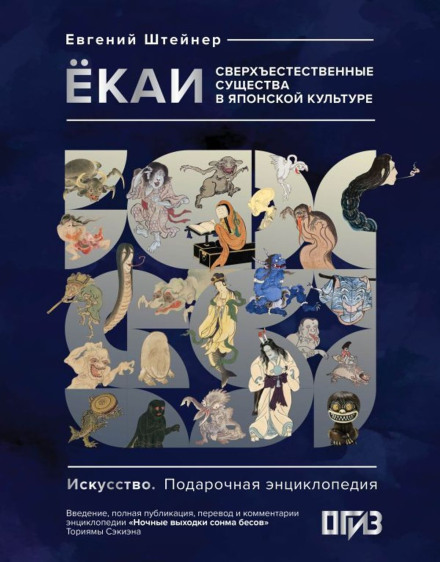
Yokai: Supernatural Creatures in Japanese Culture
9 hrs. 48 min.
Language
Russian
Author
Evgeniy Shteyner
Author
Evgeniy Shteyner
Narrator
Evgeniy Shteiner
Narrator
Evgeniy Shteiner
Description
An illustrated monograph with a complete translation and detailed commentaries on the encyclopedia “Nighttime Hijinks of the Host of Demons” by Toriyama Sekien—an essential work on Japanese demonology. The edition includes an introductory article, the full publication of the cycle, translations of inscriptions from the woodblock prints, and explanations of each image.
The author of the book is Yevgeny Semyonovich Steiner, a Japanologist, Candidate of Philological Sciences and Doctor of Arts. He worked at the Pushkin State Museum of Fine Arts, taught and conducted research at universities in Moscow, Jerusalem, Tokyo, Yokohama, New York, Manchester, and London. Steiner is the author of more than fifteen books published in Russia, the USA, the UK, and Germany, including: “In the Swirl of the Mortal World: Japanese Art and Its Collector Sergey Kitaev” (NLO, 2022), “Pictures of the Heart: Ideas and Images of Old Japan” (“St. Petersburg Oriental Studies,” 2021), “Pictures of the World: The Visual in the History of Culture” (“St. Petersburg Oriental Studies,” 2024), and others. His four-volume work “Hokusai Manga: An Encyclopedia of Old Japanese Life in Pictures” (2016) received the “Book of the Year” and “Enlightener” awards in 2017 (a special nomination).
Toriyama Sekien (1712–1788) was an artist of the Edo period who devoted his main work to an attempt to systematize, across several series of woodblock prints, all the beings of the Japanese world of yōkai—participants of the Hyakki Yagyō, the annual secret nighttime procession of the unclean. His “bestiary” became the first major effort to transfer these stories into a book format and into the technique of wood engraving. Four volumes were printed in large runs, repeatedly reissued, and became widely disseminated.
In traditional Japanese conceptions, the surrounding reality is not only what the eye can see, but a permeable coexistence of the human world with the divine and demonic. The “other world” is not separated by a boundary: it is nearby and capable of interfering in everyday life. Gods and spirits, souls of the dead, mountain and forest beings, water unclean things, and even objects such as an old umbrella or a pot could become actors in human life.
In Steiner’s book, a reprint of the 1805 edition is published, printed from the old blocks of the first issue of the encyclopedia (1776–1784). In four volumes, 211 images of characters are collected. The edition is designed both for a broad readership—art and Japanese culture lovers—and for specialists—Japanologists and China scholars; it can serve as a convenient reference work.
Sekien’s special tone is emphasized separately: his unclean beings are both frightening and amusing, and humor becomes a way to “tame” fear and cope with real troubles that take on mythological form. These images continue to live in modern mass culture—in anime, manga, and many other media. Design: LLC “AST Publishing House,” 2025.
The author of the book is Yevgeny Semyonovich Steiner, a Japanologist, Candidate of Philological Sciences and Doctor of Arts. He worked at the Pushkin State Museum of Fine Arts, taught and conducted research at universities in Moscow, Jerusalem, Tokyo, Yokohama, New York, Manchester, and London. Steiner is the author of more than fifteen books published in Russia, the USA, the UK, and Germany, including: “In the Swirl of the Mortal World: Japanese Art and Its Collector Sergey Kitaev” (NLO, 2022), “Pictures of the Heart: Ideas and Images of Old Japan” (“St. Petersburg Oriental Studies,” 2021), “Pictures of the World: The Visual in the History of Culture” (“St. Petersburg Oriental Studies,” 2024), and others. His four-volume work “Hokusai Manga: An Encyclopedia of Old Japanese Life in Pictures” (2016) received the “Book of the Year” and “Enlightener” awards in 2017 (a special nomination).
Toriyama Sekien (1712–1788) was an artist of the Edo period who devoted his main work to an attempt to systematize, across several series of woodblock prints, all the beings of the Japanese world of yōkai—participants of the Hyakki Yagyō, the annual secret nighttime procession of the unclean. His “bestiary” became the first major effort to transfer these stories into a book format and into the technique of wood engraving. Four volumes were printed in large runs, repeatedly reissued, and became widely disseminated.
In traditional Japanese conceptions, the surrounding reality is not only what the eye can see, but a permeable coexistence of the human world with the divine and demonic. The “other world” is not separated by a boundary: it is nearby and capable of interfering in everyday life. Gods and spirits, souls of the dead, mountain and forest beings, water unclean things, and even objects such as an old umbrella or a pot could become actors in human life.
In Steiner’s book, a reprint of the 1805 edition is published, printed from the old blocks of the first issue of the encyclopedia (1776–1784). In four volumes, 211 images of characters are collected. The edition is designed both for a broad readership—art and Japanese culture lovers—and for specialists—Japanologists and China scholars; it can serve as a convenient reference work.
Sekien’s special tone is emphasized separately: his unclean beings are both frightening and amusing, and humor becomes a way to “tame” fear and cope with real troubles that take on mythological form. These images continue to live in modern mass culture—in anime, manga, and many other media. Design: LLC “AST Publishing House,” 2025.
100%
32:10
Ёкаи. Сверхъестественные существа в японской культуре 01
35:09
Ёкаи. Сверхъестественные существа в японской культуре 02
52:35
Ёкаи. Сверхъестественные существа в японской культуре 03
33:47
Ёкаи. Сверхъестественные существа в японской культуре 04
03:09
Ёкаи. Сверхъестественные существа в японской культуре 05
52:15
Ёкаи. Сверхъестественные существа в японской культуре 06
52:17
Ёкаи. Сверхъестественные существа в японской культуре 07
46:12
Ёкаи. Сверхъестественные существа в японской культуре 08
50:14
Ёкаи. Сверхъестественные существа в японской культуре 09
50:32
Ёкаи. Сверхъестественные существа в японской культуре 10
38:49
Ёкаи. Сверхъестественные существа в японской культуре 11
55:31
Ёкаи. Сверхъестественные существа в японской культуре 12
49:11
Ёкаи. Сверхъестественные существа в японской культуре 13
36:13
Ёкаи. Сверхъестественные существа в японской культуре 14
