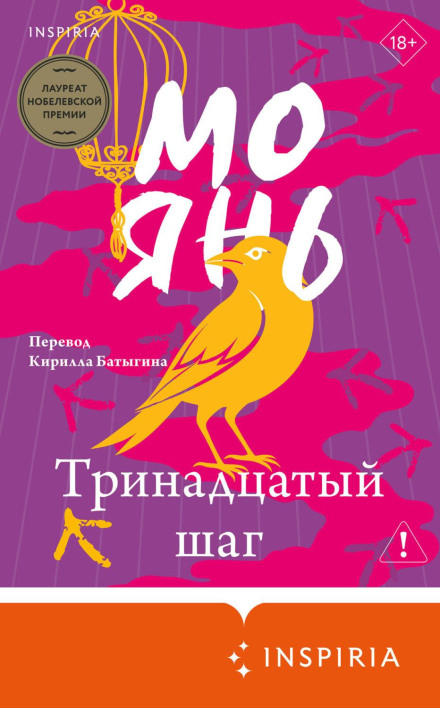
The Thirteenth Step
16 hrs. 37 min.
Description
"Let all of this not have been real—that it could have happened; moreover, as if it were obliged to happen".
At the center of the novel is a madman locked in a cage in the middle of a zoo. No one knows who he is. He gnaws bright chalk and, as if confessing, tells his listeners stories about incomprehensible miracles that took place in other people’s lives. For example, a physics teacher from a provincial school—exhausted to the limit—collapses right onto the lectern during a lesson and thus accepts his “glorious” death…
Dense imagery, living characters, recurring symbols, folkloric motifs, and juicy sayings lead the reader from the first page to the last. Each reader will experience this plot like a maze along their own route. Where does the dream end and where does reality begin? What here is life, and what is death? Is it a fabrication or the truth? And at what moment does an ordinary step become—fateful?
"The Thirteenth Step" is a rare chance to look inside the Chinese 1980s: a time that today is often remembered as the era of "great hopes," though for those who lived then it was not necessarily bright. China of reforms—already underway, but still without tangible results; a country of contrasts, where familiar rules are breaking down, and where grotesque and absurdity reign. If Kafka had been Chinese and lived in the "long eighties," this is how a local version of "The Castle" might look. But we have Mo Yan—and we have "The Thirteenth Step"." — Ivan Zuenko, Sinologist, historian, Associate Professor at the Department of Oriental Studies, MGIMO, Ministry of Foreign Affairs of Russia
"This novel is a modernist trap. Mo Yan deliberately destroys the order of time and plays with the reader: he removes characters, brings them back, and replaces one with another. He pushes us out of the world of art into extremely earthly reality—and then pulls us back again—so convincingly that the line between nightmare and everyday cruelty is almost erased. You might have heard such stories from acquaintances or encountered them in yellow journalism and thought the authors were taking everything to absurdity. In fact, they often only retell—almost verbatim—the most "ordinary" of these stories. Mo Yan takes off his pink glasses and shows a world without the promise of a happy ending. But if you reach the finale, you arrive at a point where you finally understand who you are and who you are allowed to be." — Alexey Chigadaev, Sinologist, translator, author of the Telegram channel about contemporary Asian literature "Chinese City Watch"
"Before you is simultaneously a novel-riddle, a literary performance, and a philosophical statement. This book is definitely "not for everyone," but for those who love Mo Yan—or are ready to discover him as a virtuoso storyteller—it will fit perfectly. Just be prepared to dive into narrative chaos, where no one can be trusted." — Natalia Vlasova, translator of Mo Yan ("Red Sorghum," "The Changes"), compiler-editor of collections of Chinese prose, multiple nominee of literary awards
At the center of the novel is a madman locked in a cage in the middle of a zoo. No one knows who he is. He gnaws bright chalk and, as if confessing, tells his listeners stories about incomprehensible miracles that took place in other people’s lives. For example, a physics teacher from a provincial school—exhausted to the limit—collapses right onto the lectern during a lesson and thus accepts his “glorious” death…
Dense imagery, living characters, recurring symbols, folkloric motifs, and juicy sayings lead the reader from the first page to the last. Each reader will experience this plot like a maze along their own route. Where does the dream end and where does reality begin? What here is life, and what is death? Is it a fabrication or the truth? And at what moment does an ordinary step become—fateful?
"The Thirteenth Step" is a rare chance to look inside the Chinese 1980s: a time that today is often remembered as the era of "great hopes," though for those who lived then it was not necessarily bright. China of reforms—already underway, but still without tangible results; a country of contrasts, where familiar rules are breaking down, and where grotesque and absurdity reign. If Kafka had been Chinese and lived in the "long eighties," this is how a local version of "The Castle" might look. But we have Mo Yan—and we have "The Thirteenth Step"." — Ivan Zuenko, Sinologist, historian, Associate Professor at the Department of Oriental Studies, MGIMO, Ministry of Foreign Affairs of Russia
"This novel is a modernist trap. Mo Yan deliberately destroys the order of time and plays with the reader: he removes characters, brings them back, and replaces one with another. He pushes us out of the world of art into extremely earthly reality—and then pulls us back again—so convincingly that the line between nightmare and everyday cruelty is almost erased. You might have heard such stories from acquaintances or encountered them in yellow journalism and thought the authors were taking everything to absurdity. In fact, they often only retell—almost verbatim—the most "ordinary" of these stories. Mo Yan takes off his pink glasses and shows a world without the promise of a happy ending. But if you reach the finale, you arrive at a point where you finally understand who you are and who you are allowed to be." — Alexey Chigadaev, Sinologist, translator, author of the Telegram channel about contemporary Asian literature "Chinese City Watch"
"Before you is simultaneously a novel-riddle, a literary performance, and a philosophical statement. This book is definitely "not for everyone," but for those who love Mo Yan—or are ready to discover him as a virtuoso storyteller—it will fit perfectly. Just be prepared to dive into narrative chaos, where no one can be trusted." — Natalia Vlasova, translator of Mo Yan ("Red Sorghum," "The Changes"), compiler-editor of collections of Chinese prose, multiple nominee of literary awards
This audiobook has been removed at the request of the copyright holder.
