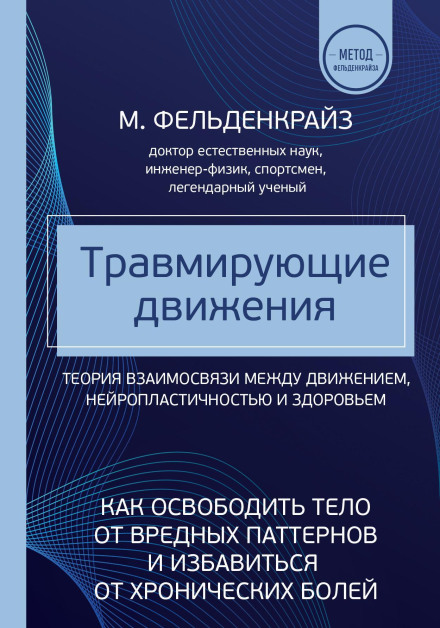
Awareness Through Movement
6 hrs. 52 min.
Language
Russian
Author
Moshe Feldenkrais
Author
Moshe Feldenkrais
Narrator
Pavel Lomakin
Narrator
Pavel Lomakin
Description
“Traumatic Movements” is one of the most gripping books by Moshe Feldenkrais. It is constructed as a conversation and reflection, in which exploring a paradox—our inability to most clearly perceive what we do most often—runs like a common thread. At the same time, the book gathers and summarizes many other of his striking insights, and shows how, step by step, he developed his ideas for helping with different brain-related disorders.
Classes using the Feldenkrais method (also called lessons) are based on carefully tracking one’s own movements—either in the form of group practice “Awareness Through Movement” or during an individual session with a practitioner known as “Functional Integration.” In both formats, a person is gently guided through a sequence of very delicate, almost imperceptible movements, intended to activate both awareness and the nervous system.
This approach can be useful for people after a stroke, children with special needs, those who have experienced traumatic brain injuries, people living with cerebral palsy and other serious conditions. It is also applicable to more everyday cases, where unsuccessful movement habits have become established: for back and joint pain, sleep disorders, nervous exhaustion, and chronic physical and emotional tension.
Classes using the Feldenkrais method (also called lessons) are based on carefully tracking one’s own movements—either in the form of group practice “Awareness Through Movement” or during an individual session with a practitioner known as “Functional Integration.” In both formats, a person is gently guided through a sequence of very delicate, almost imperceptible movements, intended to activate both awareness and the nervous system.
This approach can be useful for people after a stroke, children with special needs, those who have experienced traumatic brain injuries, people living with cerebral palsy and other serious conditions. It is also applicable to more everyday cases, where unsuccessful movement habits have become established: for back and joint pain, sleep disorders, nervous exhaustion, and chronic physical and emotional tension.
100%
35:30
Травмирующие движения. Как освободить тело от вредных паттернов и избавиться от хронических болей 01
05:50
Травмирующие движения. Как освободить тело от вредных паттернов и избавиться от хронических болей 02
02:16
Травмирующие движения. Как освободить тело от вредных паттернов и избавиться от хронических болей 03
30:43
Травмирующие движения. Как освободить тело от вредных паттернов и избавиться от хронических болей 04
37:41
Травмирующие движения. Как освободить тело от вредных паттернов и избавиться от хронических болей 05
22:36
Травмирующие движения. Как освободить тело от вредных паттернов и избавиться от хронических болей 06
40:16
Травмирующие движения. Как освободить тело от вредных паттернов и избавиться от хронических болей 07
37:37
Травмирующие движения. Как освободить тело от вредных паттернов и избавиться от хронических болей 08
16:00
Травмирующие движения. Как освободить тело от вредных паттернов и избавиться от хронических болей 09
23:10
Травмирующие движения. Как освободить тело от вредных паттернов и избавиться от хронических болей 10
1:15:30
Травмирующие движения. Как освободить тело от вредных паттернов и избавиться от хронических болей 11
59:35
Травмирующие движения. Как освободить тело от вредных паттернов и избавиться от хронических болей 12
18:37
Травмирующие движения. Как освободить тело от вредных паттернов и избавиться от хронических болей 13
05:32
Травмирующие движения. Как освободить тело от вредных паттернов и избавиться от хронических болей 14
01:52
Травмирующие движения. Как освободить тело от вредных паттернов и избавиться от хронических болей 15
