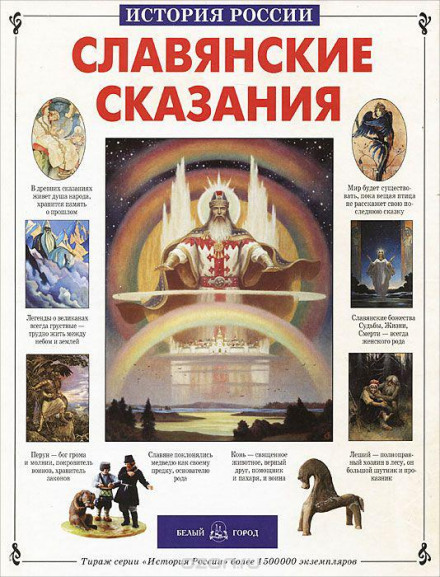
Slavic Legends
1 hr. 44 min.
Language
Russian
Author
Lavrova Svetlana
Author
Lavrova Svetlana
Narrator
Elena Soboleva
Narrator
Elena Soboleva
Description
The legends are built according to the principle that the text of the legend itself is interwoven with historical notes or someone’s retelling of a conversation.
Slavic mythology, especially that of the Eastern (Russian) Slavs, remained little studied until the 19th century. It was as if it didn’t exist. This is connected both with the Christianization of the Slavs, as a result of which myths were consigned to oblivion, and with the consequence of that process—the loss of original mythological texts. Modern times are marked by a surge of interest in folklore, ethnography, and mythology—not only Russian and pan-Slavic, but also proto-Slavic, which, having adapted in many ways to Christianity, continued to exist in a variety of forms of oral folk art.
Ancient pagan cult involved the deification of nature, and man’s first knowledge of it was at the same time his religion. That is why, in a certain sense, pagan mythology also includes beliefs, superstitious signs, ritual songs, folk tales, and legends. Slavic mythology is comprehensive: it covers all aspects of human existence—from belief in leshies and household spirits to an agricultural calendar, from ritual rites to identifying the pagan Perun with the Christian saint Elijah the Prophet. Therefore it continues to live—in images, in symbolism, in rituals, and in the very language.
Slavic mythology, especially that of the Eastern (Russian) Slavs, remained little studied until the 19th century. It was as if it didn’t exist. This is connected both with the Christianization of the Slavs, as a result of which myths were consigned to oblivion, and with the consequence of that process—the loss of original mythological texts. Modern times are marked by a surge of interest in folklore, ethnography, and mythology—not only Russian and pan-Slavic, but also proto-Slavic, which, having adapted in many ways to Christianity, continued to exist in a variety of forms of oral folk art.
Ancient pagan cult involved the deification of nature, and man’s first knowledge of it was at the same time his religion. That is why, in a certain sense, pagan mythology also includes beliefs, superstitious signs, ritual songs, folk tales, and legends. Slavic mythology is comprehensive: it covers all aspects of human existence—from belief in leshies and household spirits to an agricultural calendar, from ritual rites to identifying the pagan Perun with the Christian saint Elijah the Prophet. Therefore it continues to live—in images, in symbolism, in rituals, and in the very language.
100%
00:29
00_00_Lavrova_S_Slavyanskie_skazaniya_Soboleva_E
01:41
00_01_Soderzhanie
03:21
01_Oskolki rabitogo mira. Golosa dalekih predkov
07:22
02_Neprostaya ptichka utochka. Skazanie o sotvorenii mira
05:08
03_Otkuda berutsya oleni. Skazaniya o svyaschennyh zhivotnyh
06:07
04_Daleko li do Bolovodya. Skazaniya o schastlivyh zemlyah
08:29
05_Glavnye slavyanskie bogi. Skazaniya o Perune i Velese
04:58
06_Ranshe on byl uraganom. Skazanie o Vie
06:23
07_Odnazhdy lunnoy nochyu. Skazanie o volkah i ih pastyre
05:41
08_Kost zemli. Skazanie o kamnyah
05:54
09_Daleko li do neba. Skazanie o zvezdah
09:28
10_Tsvetok, kotorogo ne mozhet byt. skazanie o tsvetke paporotnika
06:25
11_Provodnik doveriya. Skazanie o chistom ogne
07:06
12_Kol v Zemle. Skazanie o lihoradkah
04:33
13_Umnee chem lyudi. Skazanie o kone
04:45
14_Raznotsvetnyy most. Skazanie o raduge
04:14
15_Gory letuchie. Skazanie ob oblakah
04:10
16_Trudno byt ne takim kak vse. Skazanie o velikanah
04:05
17_Strashnyy lik. Skazanie o chume
04:06
18_Kto komanduet pogodoy. Skazanie o volhvah - oblakoprogonnikah
