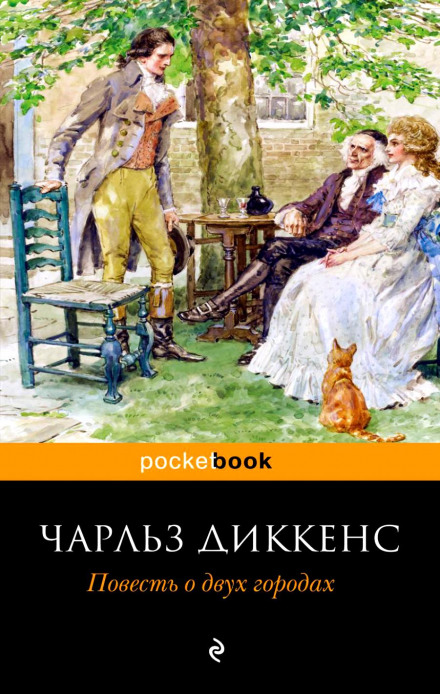
A Tale of Two Cities
18 hrs. 51 min.
Language
Russian
Author
Charles Dickens
Author
Charles Dickens
Narrator
Arkady Bukhmin
Narrator
Arkady Bukhmin
Description
The events of Charles Dickens’ novel take place at the end of the 18th century in two cities—London and Paris—when an English king with a broad jaw and a queen with an ugly face sat on the English throne, and on the French throne sat a king with a broad jaw and a queen with a beautiful face. “It was the best of times, it was the worst of times.”
The noblemen of both states were firmly convinced that everything around was prosperous and solidly established once and for all. But the French people disrupted the balance, stormed the Bastille, set up a guillotine in its place—and the heads of noblemen rolled one after another.
Charles Darnay, an English aristocrat who once had renounced his French past, is forced by extraordinary circumstances to leave his young family and go to Paris, engulfed by the wild fire of freedom.
A Tale of Two Cities is a novel with hundreds of millions of reprints, repeatedly adapted for film and brought to the stage, and to this day remains one of the most in-demand books of English literature.
“All that I have suffered and endured on these pages was felt by me; I have endured and suffered all of it myself.
All the details I present, including the smallest ones, about the state of the French people before and during the revolution are entirely reliable, since they are based on the testimony of eyewitnesses who deserve absolute trust. I, incidentally, flattered myself with the hope that this book would help a wide circle of readers to form a picture of the external side of that terrible time; as for understanding its inner meaning, after the extraordinary book of Mr. Carlyle (The French Revolution, note.) it is hardly possible for anyone to hope to say anything new in this field.”
The noblemen of both states were firmly convinced that everything around was prosperous and solidly established once and for all. But the French people disrupted the balance, stormed the Bastille, set up a guillotine in its place—and the heads of noblemen rolled one after another.
Charles Darnay, an English aristocrat who once had renounced his French past, is forced by extraordinary circumstances to leave his young family and go to Paris, engulfed by the wild fire of freedom.
A Tale of Two Cities is a novel with hundreds of millions of reprints, repeatedly adapted for film and brought to the stage, and to this day remains one of the most in-demand books of English literature.
“All that I have suffered and endured on these pages was felt by me; I have endured and suffered all of it myself.
All the details I present, including the smallest ones, about the state of the French people before and during the revolution are entirely reliable, since they are based on the testimony of eyewitnesses who deserve absolute trust. I, incidentally, flattered myself with the hope that this book would help a wide circle of readers to form a picture of the external side of that terrible time; as for understanding its inner meaning, after the extraordinary book of Mr. Carlyle (The French Revolution, note.) it is hardly possible for anyone to hope to say anything new in this field.”
