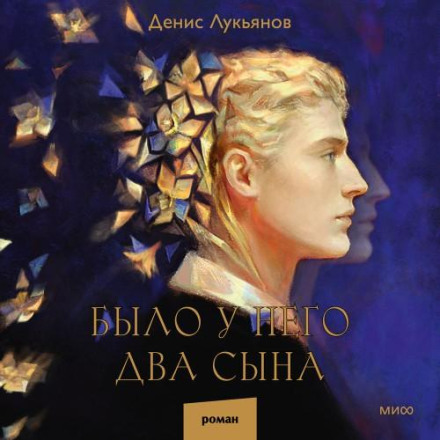
He Had Two Sons
9 hrs. 57 min.
Language
Russian
Author
Denis Lukyanov
Author
Denis Lukyanov
Narrator
Pavel Potapov
Narrator
Pavel Potapov
Description
A psychological novel with touches of magical realism—a modern retelling of the ancient Greek myth of Narcissus.
Petya grows up in a small Russian town where everyday life is alongside omens and superstitions, and from childhood dreams of becoming an artist. One day, at the door of a stranger’s apartment, he meets a man who looks exactly like him—and from that moment his familiar life falls apart and is rebuilt from scratch.
Petya finds himself in a pop-culture space, quickly makes a career in the American comics industry, and climbs higher and higher. The louder the outside world becomes and the more clearly he hears its scream, the more he dissolves in that noise and loses his own boundaries. Instead, he acquires an image—shining, flawless, like a golden ideal.
But what will happen if this reflection—his patron, double, and shadow—one day decides it no longer wants to accompany him, but to replace him?
From the author
“Once he had two sons” is a story about the confrontation of two comics creators, a mystical and modern reinterpretation of the myth of Narcissus, as well as the motifs of fairy tales about brothers and doubles. The text is built on a mirror principle: everything splits into two, rhymes, and enters into conflict—characters, images, spaces. Russian province argues with the metropolis; a superstitious way of life with pop culture; the nanny Vasílisa with Grandmother Medea. The novel is mystical, with tones that may remind one of Wilde, Dostoevsky, Nabokov, and possibly Yevgeniya Nekrasova. It is saturated with references—from the mysterious Doctor Anansi to the little Luzhin.
But first and foremost, it’s a story about creative dependency, the inability to live through and heal one’s inner wounds—about the world pain the hero hears: a child of the millennium born in the two-thousands. And it is written entirely in the second person. Why? Because whose story could be told in such a voice, if not Narcissus’s—through the voice of his reflection?
Petya grows up in a small Russian town where everyday life is alongside omens and superstitions, and from childhood dreams of becoming an artist. One day, at the door of a stranger’s apartment, he meets a man who looks exactly like him—and from that moment his familiar life falls apart and is rebuilt from scratch.
Petya finds himself in a pop-culture space, quickly makes a career in the American comics industry, and climbs higher and higher. The louder the outside world becomes and the more clearly he hears its scream, the more he dissolves in that noise and loses his own boundaries. Instead, he acquires an image—shining, flawless, like a golden ideal.
But what will happen if this reflection—his patron, double, and shadow—one day decides it no longer wants to accompany him, but to replace him?
From the author
“Once he had two sons” is a story about the confrontation of two comics creators, a mystical and modern reinterpretation of the myth of Narcissus, as well as the motifs of fairy tales about brothers and doubles. The text is built on a mirror principle: everything splits into two, rhymes, and enters into conflict—characters, images, spaces. Russian province argues with the metropolis; a superstitious way of life with pop culture; the nanny Vasílisa with Grandmother Medea. The novel is mystical, with tones that may remind one of Wilde, Dostoevsky, Nabokov, and possibly Yevgeniya Nekrasova. It is saturated with references—from the mysterious Doctor Anansi to the little Luzhin.
But first and foremost, it’s a story about creative dependency, the inability to live through and heal one’s inner wounds—about the world pain the hero hears: a child of the millennium born in the two-thousands. And it is written entirely in the second person. Why? Because whose story could be told in such a voice, if not Narcissus’s—through the voice of his reflection?
100%
02:39
01
1:27:46
02
2:01:41
03
1:35:03
04
1:12:03
05
1:12:32
06
1:09:14
07
1:16:12
08
