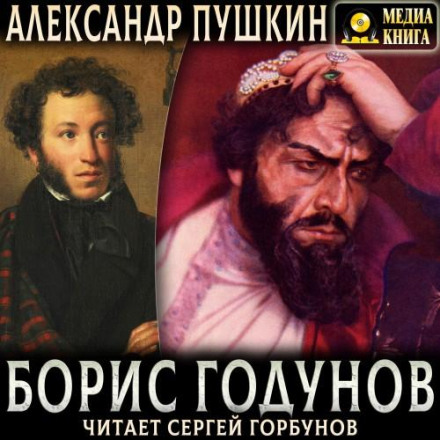
Boris Godunov
2 hrs. 5 min.
Language
Russian
Author
Alexander Pushkin
Author
Alexander Pushkin
Narrator
Sergey Gorbunov
Narrator
Sergey Gorbunov
Description
One of the most significant works of Russian literature
“Boris Godunov” is a historical drama about the Time of Troubles—and the main Russian historical drama of all. Drawing on Shakespeare and Karamzin, Pushkin blends languages and styles and reveals a deep psychological problematics in Russian history.
Russia, the turn of the 16th–17th centuries. After six years of Boris Godunov’s rule, turmoil ripens in the country: a impostor appears—the fugitive monk Grigory Otrepyev—who presents himself as the son of Ivan the Terrible, Tsarevich Dmitry, killed on Boris’s orders. The impostor, backed by the Poles, marches on Moscow. Boris dies; the boyars, having killed the queen and the heir, proclaim the impostor as the new tsar. The point of Pushkin’s tragedy lies not only—and not so much—in staging authentic historical events, but in presenting, on historical material, universal “eternal” questions: political (is usurpation of power permissible?), moral (can one do good by committing evil once?), and psychological (what is the price of repentance for what has been done?).
“Boris Godunov” is a historical drama about the Time of Troubles—and the main Russian historical drama of all. Drawing on Shakespeare and Karamzin, Pushkin blends languages and styles and reveals a deep psychological problematics in Russian history.
Russia, the turn of the 16th–17th centuries. After six years of Boris Godunov’s rule, turmoil ripens in the country: a impostor appears—the fugitive monk Grigory Otrepyev—who presents himself as the son of Ivan the Terrible, Tsarevich Dmitry, killed on Boris’s orders. The impostor, backed by the Poles, marches on Moscow. Boris dies; the boyars, having killed the queen and the heir, proclaim the impostor as the new tsar. The point of Pushkin’s tragedy lies not only—and not so much—in staging authentic historical events, but in presenting, on historical material, universal “eternal” questions: political (is usurpation of power permissible?), moral (can one do good by committing evil once?), and psychological (what is the price of repentance for what has been done?).
100%
1:01:31
01
1:03:39
02
